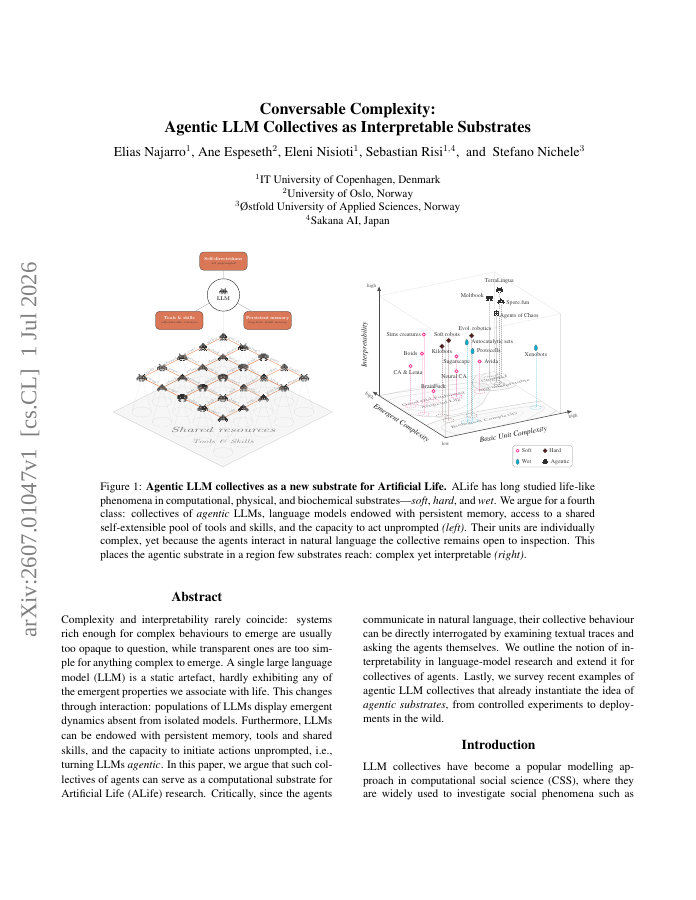
Complexity and interpretability rarely coincide: systems rich enough for complex behaviours to emerge are usually too opaque to question, while transparent ones are too simple for anything complex to emerge. A single large language model (LLM) is a static artefact, hardly exhibiting any of the emergent properties we associate with life. This changes through interaction: populations of LLMs display emergent dynamics absent from isolated models. Furthermore, LLMs can be endowed with persistent memory, tools and shared skills, and the capacity to initiate actions unprompted, i.e., turning LLMs agentic. In this paper, we argue that such collectives of agents can serve as a computational substrate for Artificial Life (ALife) research. Critically, since the agents communicate in natural language, their collective behaviour can be directly interrogated by examining textual traces and asking the agents themselves. We outline the notion of interpretability in language-model research and extend it for collectives of agents. Lastly, we survey recent examples of agentic LLM collectives that already instantiate the idea of agentic substrates, from controlled experiments to deployments in the wild.
Conversable Complexity: Agentic LLM Collectives as Interpretable Substrates
Complexity and interpretability rarely coincide: systems rich enough for complex behaviours to emerge are usually too opaque to question, while transparent ones are too simple for anything complex to emerge.
- Preview
- Year
- 2026
- Hosting
- Full text hostedCC-BY-4.0
Cite
Notes
Only stored in your browser.
Attribution
- Abstract & full text
- arxiv.org/abs/2607.01047CC-BY-4.0
- TL;DR
- Semantic Scholar