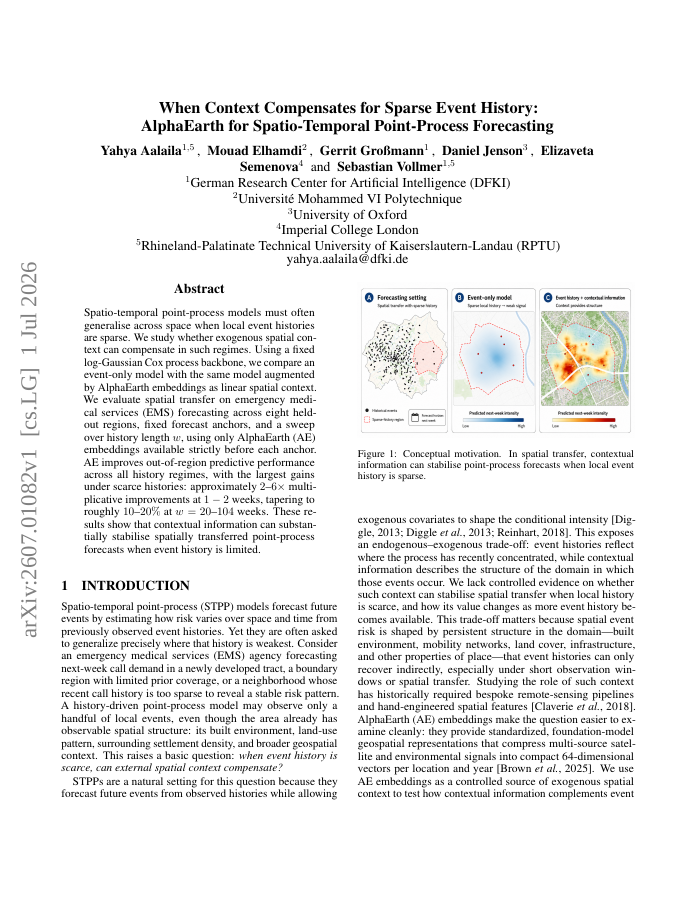
Spatio-temporal point-process models must often generalise across space when local event histories are sparse. We study whether exogenous spatial context can compensate in such regimes. Using a fixed log-Gaussian Cox process backbone, we compare an event-only model with the same model augmented by AlphaEarth embeddings as linear spatial context. We evaluate spatial transfer on emergency medical services (EMS) forecasting across eight held-out regions, fixed forecast anchors, and a sweep over history length w, using only AlphaEarth (AE) embeddings available strictly before each anchor. AE improves out-of-region predictive performance across all history regimes, with the largest gains under scarce histories: approximately 2--6\times multiplicative improvements at 1-2 weeks, tapering to roughly 10--20% at w=20--104 weeks. These results show that contextual information can substantially stabilise spatially transferred point-process forecasts when event history is limited.
When Context Compensates for Sparse Event History: AlphaEarth for Spatio-Temporal Point-Process Forecasting
Spatio-temporal point-process models must often generalise across space when local event histories are sparse. We study whether exogenous spatial context can compensate in such regimes.
- Preview
- Year
- 2026
- Hosting
- Abstract onlyARXIV-DEFAULT
Cite
Notes
Only stored in your browser.
Attribution
- Abstract & full text
- arxiv.org/abs/2607.01082ARXIV-DEFAULT
- TL;DR
- Semantic Scholar