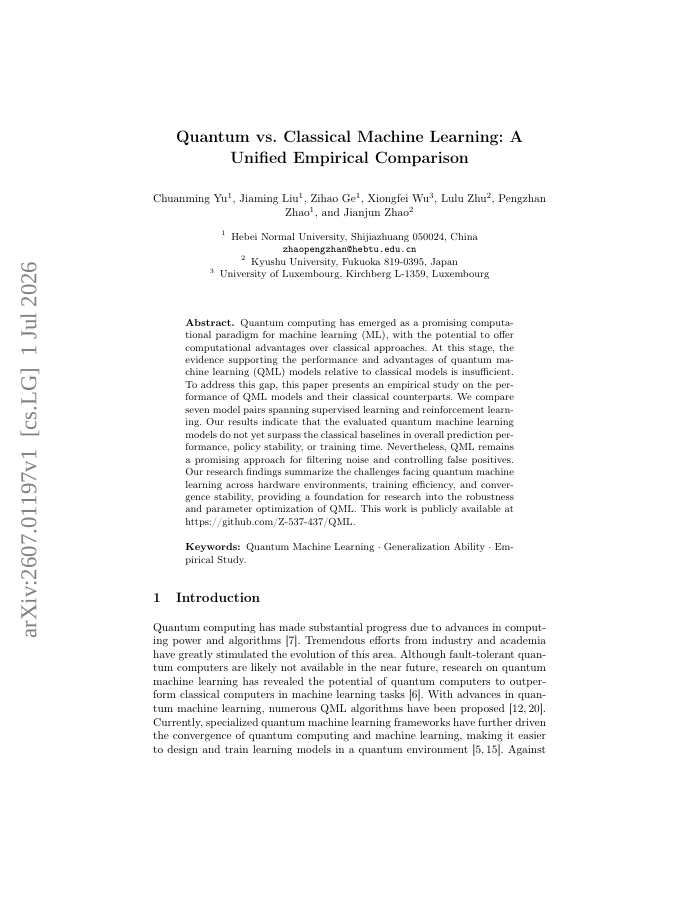
Quantum computing has emerged as a promising computational paradigm for machine learning (ML), with the potential to offer computational advantages over classical approaches. At this stage, the evidence supporting the performance and advantages of quantum machine learning (QML) models relative to classical models is insufficient.To address this gap, this paper presents an empirical study on the performance of QML models and their classical counterparts. We compare seven model pairs spanning supervised learning and reinforcement learning. Our results indicate that the evaluated quantum machine learning models do not yet surpass the classical baselines in overall prediction performance, policy stability, or training time. Nevertheless, QML remains a promising approach for filtering noise and controlling false positives. Our research findings summarize the challenges facing quantum machine learning across hardware environments, training efficiency, and convergence stability, providing a foundation for research into the robustness and parameter optimization of QML. This work is publicly available at https://github.com/Z-537-437/QML.
Quantum vs. Classical Machine Learning: A Unified Empirical Comparison
Quantum computing has emerged as a promising computational paradigm for machine learning (ML), with the potential to offer computational advantages over classical approaches.
- Preview
- Year
- 2026
- Hosting
- Full text hostedCC-BY-4.0
Cite
Notes
Only stored in your browser.
Attribution
- Abstract & full text
- arxiv.org/abs/2607.01197CC-BY-4.0
- TL;DR
- Semantic Scholar