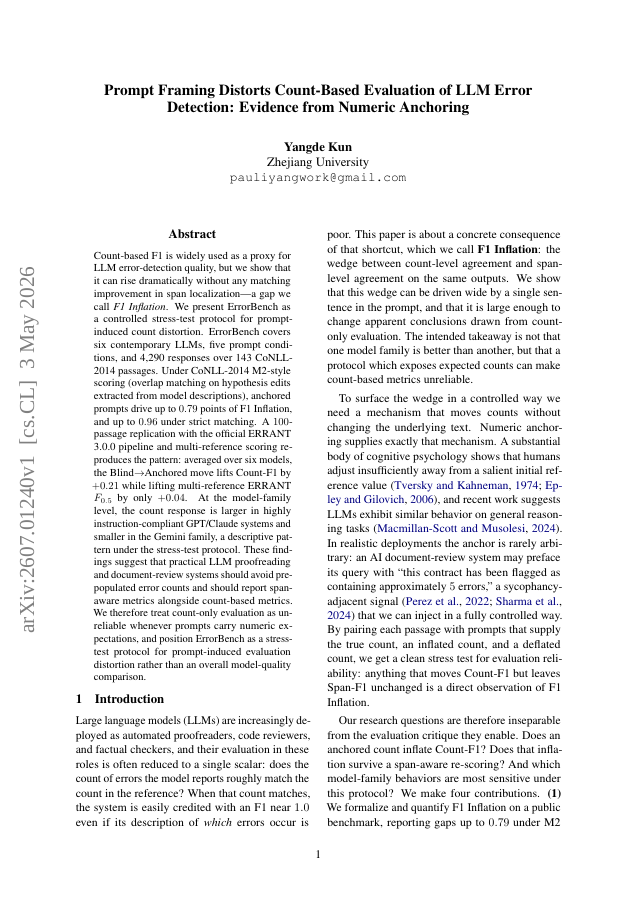
Count-based F1 is widely used as a proxy for LLM error-detection quality, but this paper shows that it can rise dramatically without a corresponding improvement in span localization, a gap termed F1 Inflation. The paper introduces ErrorBench, a controlled stress-test protocol for prompt-induced count distortion. ErrorBench evaluates six contemporary LLMs under five prompt conditions over 4,290 responses from 143 CoNLL-2014 passages. Under CoNLL-2014 M2-style scoring, anchored prompts produce up to 0.79 points of F1 Inflation, and up to 0.96 under strict matching. A 100-passage replication using the official ERRANT 3.0.0 pipeline and multi-reference scoring reproduces the pattern: averaged over six models, the Blind-to-Anchored prompt shift raises Count-F1 by +0.21 while raising multi-reference ERRANT F0.5 by only +0.04. The study finds larger count responses in highly instruction-compliant GPT/Claude systems and smaller responses in the Gemini family under this stress-test protocol. The findings suggest that LLM proofreading and document-review evaluations should avoid pre-populated error counts and should report span-aware metrics alongside count-based metrics.
Prompt Framing Distorts Count-Based Evaluation of LLM Error Detection: Evidence from Numeric Anchoring
Count-based F1 is widely used as a proxy for LLM error-detection quality, but this paper shows that it can rise dramatically without a corresponding improvement in span localization, a gap termed F1 Inflation.
- Preview
- Year
- 2026
- Hosting
- Abstract onlyARXIV-DEFAULT
Cite
Notes
Only stored in your browser.
Attribution
- Abstract & full text
- arxiv.org/abs/2607.01240ARXIV-DEFAULT
- TL;DR
- Semantic Scholar