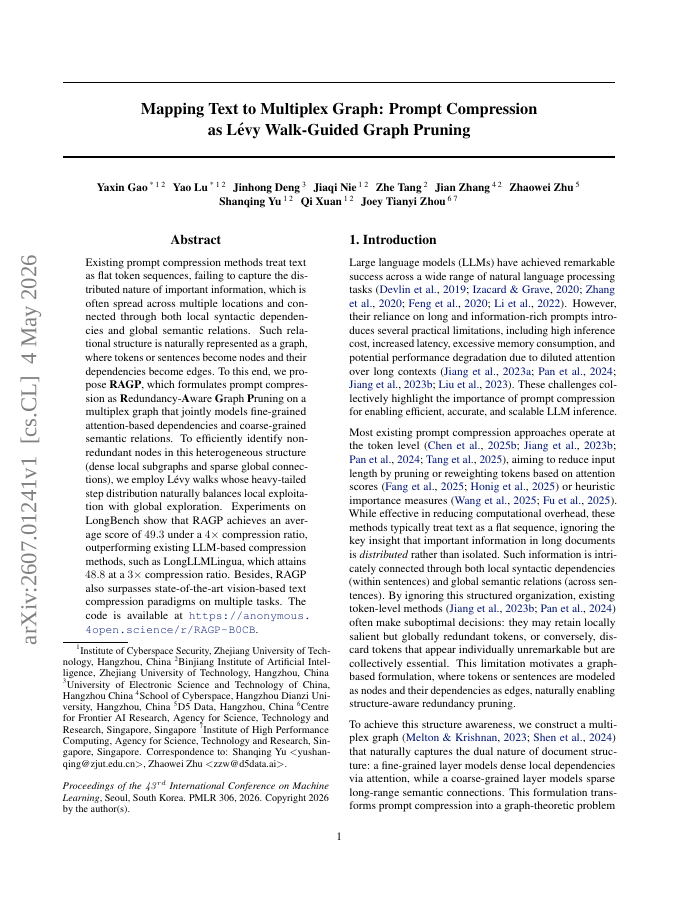
Existing prompt compression methods treat text as flat token sequences, failing to capture the distributed nature of important information, which is often spread across multiple locations and connected through both local syntactic dependencies and global semantic relations. Such relational structure is naturally represented as a graph, where tokens or sentences become nodes and their dependencies become edges. To this end, we propose RAGP, which formulates prompt compression as Redundancy-Aware Graph Pruning on a multiplex graph that jointly models fine-grained attention-based dependencies and coarse-grained semantic relations. To efficiently identify non-redundant nodes in this heterogeneous structure (dense local subgraphs and sparse global connections), we employ Levy walks whose heavy-tailed step distribution naturally balances local exploitation with global exploration. Experiments on LongBench show that RAGP achieves an average score of 49.3 under a 4x compression ratio, outperforming existing LLM-based compression methods, such as LongLLMLingua, which attains 48.8 at a 3x compression ratio. Besides, RAGP also surpasses state-of-the-art vision-based text compression paradigms on multiple tasks. The code is available at https://anonymous.4open.science/r/RAGP-B0CB.
Mapping Text to Multiplex Graph: Prompt Compression as Lévy Walk-Guided Graph Pruning
Existing prompt compression methods treat text as flat token sequences, failing to capture the distributed nature of important information, which is often spread across multiple locations and connected through both local syntactic dependencies and global semantic relations.
- Preview
- Year
- 2026
- Hosting
- Abstract onlyARXIV-DEFAULT
Cite
Notes
Only stored in your browser.
Attribution
- Abstract & full text
- arxiv.org/abs/2607.01241ARXIV-DEFAULT
- TL;DR
- Semantic Scholar