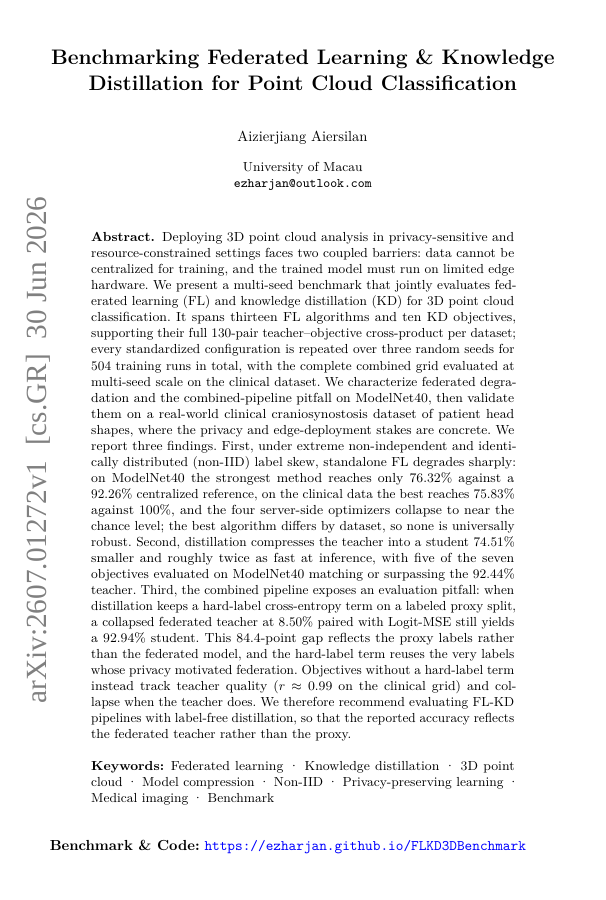
Deploying 3D point cloud analysis in privacy-sensitive, resource-constrained settings faces two barriers: data cannot be centralized, and models must run on limited edge hardware. We present a multi-seed benchmark jointly evaluating federated learning (FL) and knowledge distillation (KD) for 3D point cloud classification. It spans 13 FL algorithms and 10 KD objectives (a 130-pair cross-product) across 504 training runs, evaluated on ModelNet40 and a clinical craniosynostosis dataset. We report three findings. First, under extreme non-IID label skew, standalone FL degrades sharply: on ModelNet40, the strongest method reaches 76.32% against a 92.26% centralized reference; on clinical data, the best reaches 75.83% against 100%. Second, distillation successfully compresses the teacher into a student 74.51% smaller and roughly twice as fast at inference, often matching or surpassing the teacher. Third, the combined pipeline exposes an evaluation pitfall: when distillation keeps a hard-label cross-entropy term on a labeled proxy split, a collapsed federated teacher (8.50%) paired with Logit-MSE still yields a 92.94% student. This 84.4-point gap reflects the proxy labels rather than the federated model, reusing the very labels whose privacy motivated federation. Objectives without hard labels instead track teacher quality (r \approx 0.99) and collapse when the teacher does. We therefore recommend evaluating FL-KD pipelines with label-free distillation so reported accuracy reflects the federated teacher, not the proxy.
Benchmarking Federated Learning and Knowledge Distillation for Point Cloud Classification
Deploying 3D point cloud analysis in privacy-sensitive, resource-constrained settings faces two barriers: data cannot be centralized, and models must run on limited edge hardware.
- Preview
- Year
- 2026
- Hosting
- Full text hostedCC-BY-4.0
Cite
Notes
Only stored in your browser.
Attribution
- Abstract & full text
- arxiv.org/abs/2607.01272CC-BY-4.0
- TL;DR
- Semantic Scholar