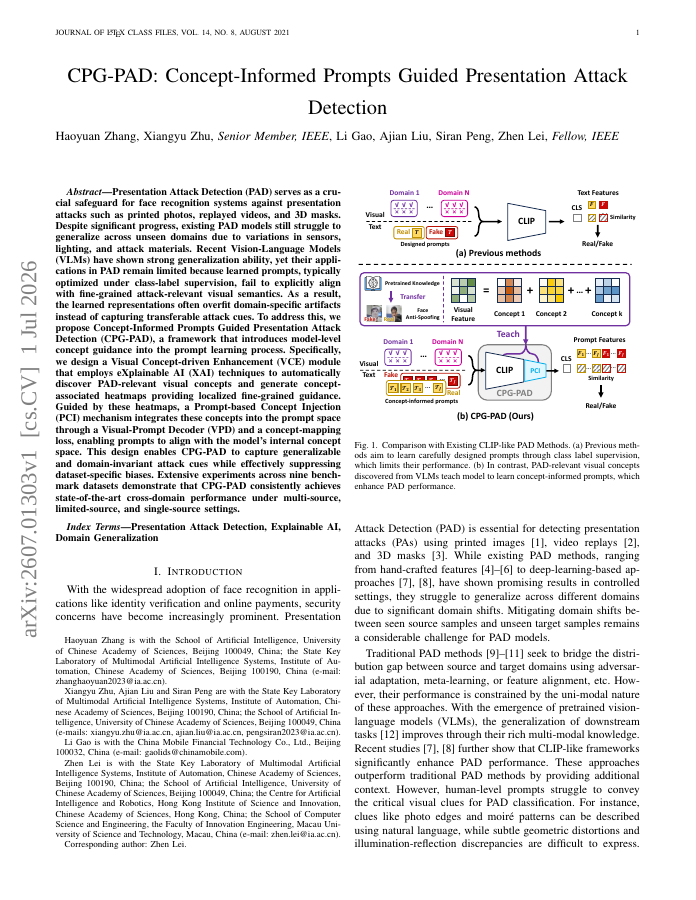
Presentation Attack Detection (PAD) serves as a crucial safeguard for face recognition systems against presentation attacks such as printed photos, replayed videos, and 3D masks. Despite significant progress, existing PAD models still struggle to generalize across unseen domains due to variations in sensors, lighting, and attack materials. Recent Vision-Language Models (VLMs) have shown strong generalization ability, yet their applications in PAD remain limited because learned prompts, typically optimized under class-label supervision, fail to explicitly align with fine-grained attack-relevant visual semantics. As a result, the learned representations often overfit domain-specific artifacts instead of capturing transferable attack cues. To address this, we propose Concept-Informed Prompts Guided Presentation Attack Detection (CPG-PAD), a framework that introduces model-level concept guidance into the prompt learning process. Specifically, we design a Visual Concept-driven Enhancement (VCE) module that employs eXplainable AI (XAI) techniques to automatically discover PAD-relevant visual concepts and generate concept-associated heatmaps providing localized fine-grained guidance. Guided by these heatmaps, a Prompt-based Concept Injection (PCI) mechanism integrates these concepts into the prompt space through a Visual-Prompt Decoder (VPD) and a concept-mapping loss, enabling prompts to align with the model's internal concept space. This design enables CPG-PAD to capture generalizable and domain-invariant attack cues while effectively suppressing dataset-specific biases. Extensive experiments across nine benchmark datasets demonstrate that CPG-PAD consistently achieves state-of-the-art cross-domain performance under multi-source, limited-source, and single-source settings.
CPG-PAD: Concept-Informed Prompts Guided Presentation Attack Detection
Presentation Attack Detection (PAD) serves as a crucial safeguard for face recognition systems against presentation attacks such as printed photos, replayed videos, and 3D masks.
- Preview
- Year
- 2026
- Hosting
- Full text hostedCC-BY-4.0
Cite
Notes
Only stored in your browser.
Attribution
- Abstract & full text
- arxiv.org/abs/2607.01303CC-BY-4.0
- TL;DR
- Semantic Scholar