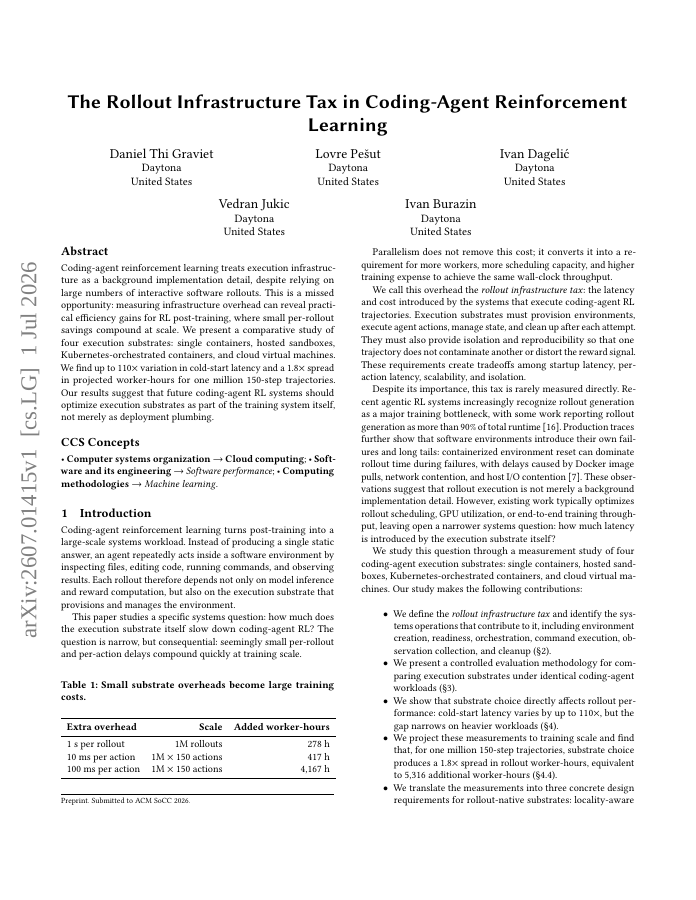
Coding-agent reinforcement learning treats execution infrastructure as a background implementation detail, despite relying on large numbers of interactive software rollouts. This is a missed opportunity: measuring infrastructure overhead can reveal practical efficiency gains for RL post-training, where small per-rollout savings compound at scale. We present a comparative study of four execution substrates: single containers, hosted sandboxes, Kubernetes-orchestrated containers, and cloud virtual machines. We find up to 110\times variation in cold-start latency and a 1.8\times spread in projected worker-hours for one million 150-step trajectories. Our results suggest that future coding-agent RL systems should optimize execution substrates as part of the training system itself, not merely as deployment plumbing.
The Rollout Infrastructure Tax in Coding-Agent Reinforcement Learning
Coding-agent reinforcement learning treats execution infrastructure as a background implementation detail, despite relying on large numbers of interactive software rollouts.
- Preview
- Year
- 2026
- Hosting
- Abstract onlyARXIV-DEFAULT
Cite
Notes
Only stored in your browser.
Attribution
- Abstract & full text
- arxiv.org/abs/2607.01415ARXIV-DEFAULT
- TL;DR
- Semantic Scholar