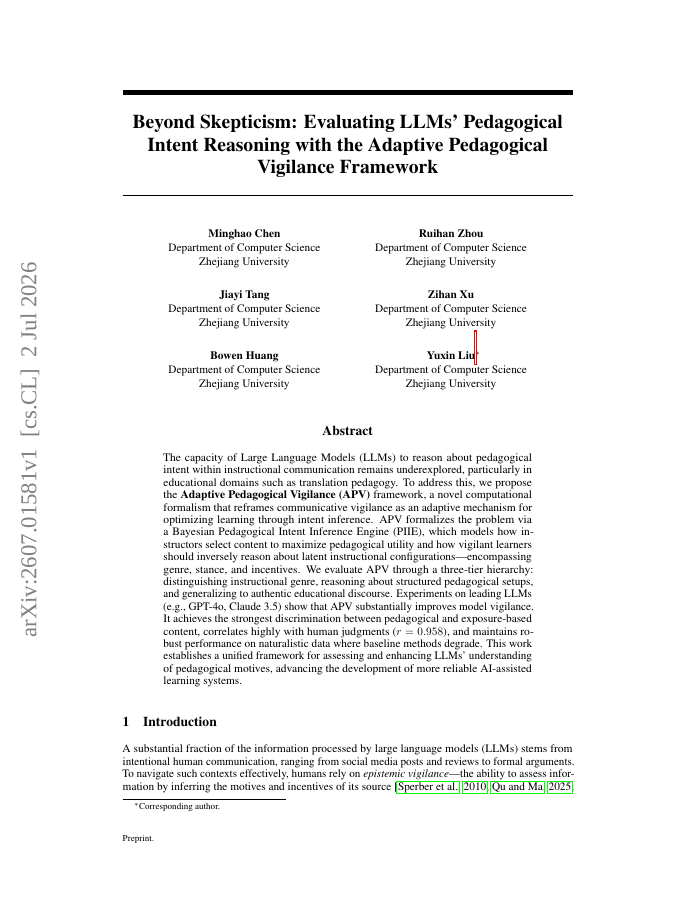
The capacity of Large Language Models (LLMs) to reason about pedagogical intent within instructional communication remains underexplored, particularly in educational domains such as translation pedagogy. To address this, we propose the Adaptive Pedagogical Vigilance (APV) framework, a novel computational formalism that reframes communicative vigilance as an adaptive mechanism for optimizing learning through intent inference. APV formalizes the problem via a Bayesian Pedagogical Intent Inference Engine (PIIE), which models how instructors select content to maximize pedagogical utility and how vigilant learners should inversely reason about latent instructional configurations -- encompassing genre, stance, and incentives. We evaluate APV through a three-tier hierarchy: distinguishing instructional genre, reasoning about structured pedagogical setups, and generalizing to authentic educational discourse. Experiments on leading LLMs (e.g., GPT-4o, Claude 3.5) show that APV substantially improves model vigilance. It achieves the strongest discrimination between pedagogical and exposure-based content, correlates highly with human judgments (r=0.958), and maintains robust performance on naturalistic data where baseline methods degrade. This work establishes a unified framework for assessing and enhancing LLMs' understanding of pedagogical motives, advancing the development of more reliable AI-assisted learning systems.
Beyond Skepticism: Evaluating LLMs Pedagogical Intent Reasoning with the Adaptive Pedagogical Vigilance Framework
The capacity of Large Language Models (LLMs) to reason about pedagogical intent within instructional communication remains underexplored, particularly in educational domains such as translation pedagogy.
- Preview
- Year
- 2026
- Hosting
- Full text hostedCC-BY-4.0
Cite
Notes
Only stored in your browser.
Attribution
- Abstract & full text
- arxiv.org/abs/2607.01581CC-BY-4.0
- TL;DR
- Semantic Scholar