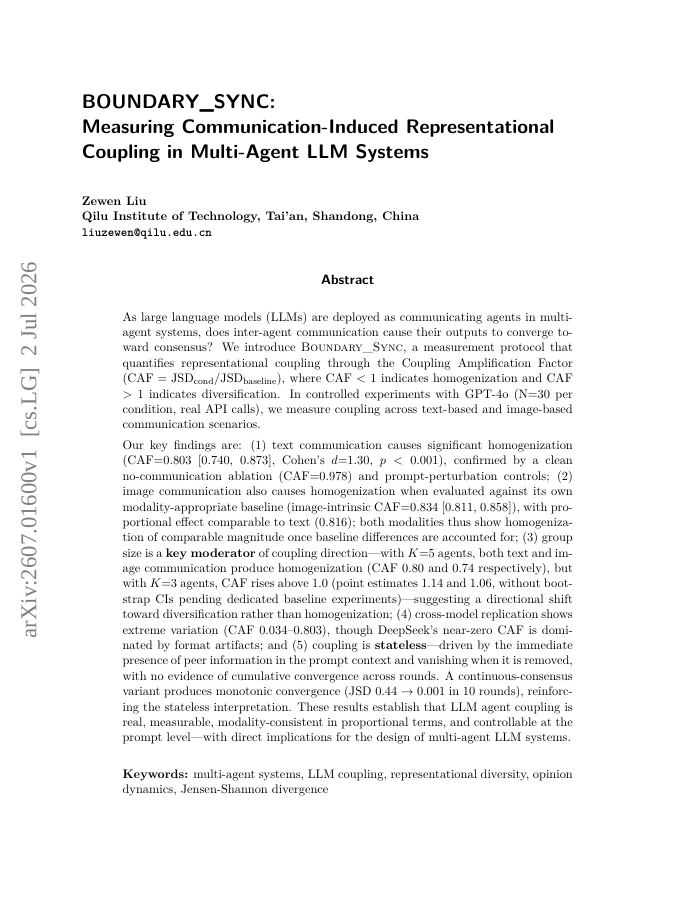
As large language models (LLMs) are deployed as communicating agents, does inter-agent communication cause outputs to converge? We introduce BOUNDARY_SYNC, a protocol measuring representational coupling via the Coupling Amplification Factor (CAF = JSD_cond / JSD_baseline), where CAF < 1 indicates homogenization and CAF > 1 indicates diversification. In controlled GPT-4o experiments (N=30, 9,900 API calls), we measure coupling in text and image communication. Key findings: (1) text communication causes significant homogenization (CAF=0.803 [0.740, 0.873], d=1.30, p<0.001), confirmed by no-communication ablation and prompt-perturbation controls; (2) image communication also homogenizes under within-modality baselines (CAF=0.834 [0.811, 0.858]), with comparable proportional effect; (3) group size moderates coupling direction -- K=5 produces homogenization while K=3 yields CAF > 1.0 (point estimates 1.14 and 1.06, CI pending), suggesting a directional shift toward diversification; (4) cross-model replication shows extreme variation (CAF 0.034-0.803), with DeepSeek dominated by format artifacts; (5) coupling is stateless -- driven by prompt context rather than cumulative updating, with continuous consensus producing monotonic convergence. These results establish LLM agent coupling as real, measurable, and controllable at the prompt level, with direct implications for multi-agent system design.
BOUNDARY_SYNC: Measuring Communication-Induced Representational Coupling in Multi-Agent LLM Systems
As large language models (LLMs) are deployed as communicating agents, does inter-agent communication cause outputs to converge? We introduce BOUNDARY_SYNC, a protocol measuring representational coupling via the Coupling Amplification Factor (CAF = JSD_cond / JSD_baseline), where…
- Preview
- Year
- 2026
- Hosting
- Full text hostedCC-BY-4.0
Cite
Notes
Only stored in your browser.
Attribution
- Abstract & full text
- arxiv.org/abs/2607.01600CC-BY-4.0
- TL;DR
- Semantic Scholar