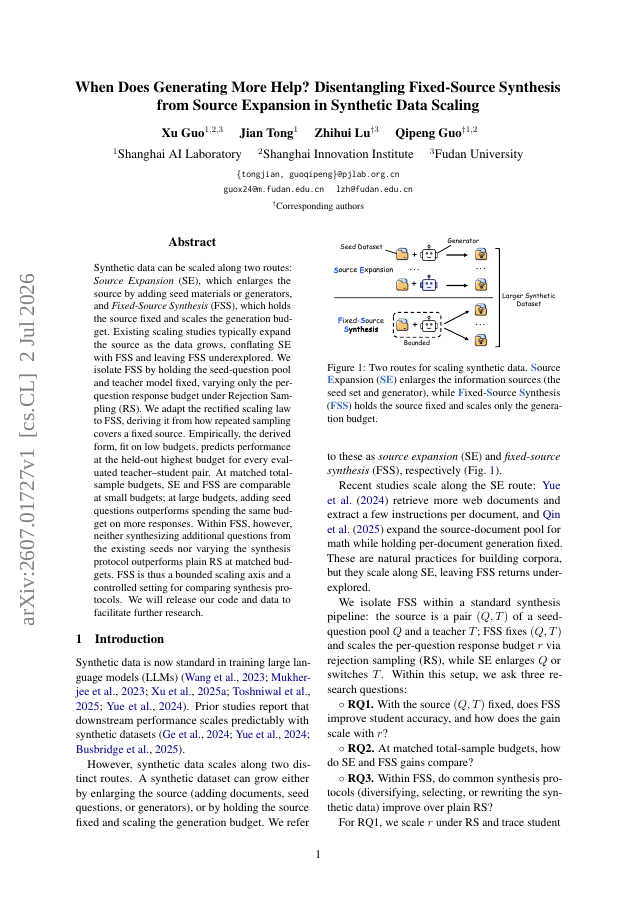
Synthetic data can be scaled along two routes: Source Expansion (SE), which enlarges the source by adding seed materials or generators, and Fixed-Source Synthesis (FSS), which holds the source fixed and scales the generation budget. Existing scaling studies typically expand the source as the data grows, conflating SE with FSS and leaving FSS underexplored. We isolate FSS by holding the seed-question pool and teacher model fixed, varying only the per-question response budget under Rejection Sampling (RS). We adapt the rectified scaling law to FSS, deriving it from how repeated sampling covers a fixed source. Empirically, the derived form, fit on low budgets, predicts performance at the held-out highest budget for every evaluated teacher--student pair. At matched total-sample budgets, SE and FSS are comparable at small budgets; at large budgets, adding seed questions outperforms spending the same budget on more responses. Within FSS, however, neither synthesizing additional questions from the existing seeds nor varying the synthesis protocol outperforms plain RS at matched budgets. FSS is thus a bounded scaling axis and a controlled setting for comparing synthesis protocols. We will release our code and data to facilitate further research.
When Does Generating More Help? Disentangling Fixed-Source Synthesis from Source Expansion in Synthetic Data Scaling
Synthetic data can be scaled along two routes: Source Expansion (SE), which enlarges the source by adding seed materials or generators, and Fixed-Source Synthesis (FSS), which holds the source fixed and scales the generation budget.
- Preview
- Year
- 2026
- Hosting
- Full text hostedCC-BY-4.0
Cite
Notes
Only stored in your browser.
Attribution
- Abstract & full text
- arxiv.org/abs/2607.01727CC-BY-4.0
- TL;DR
- Semantic Scholar