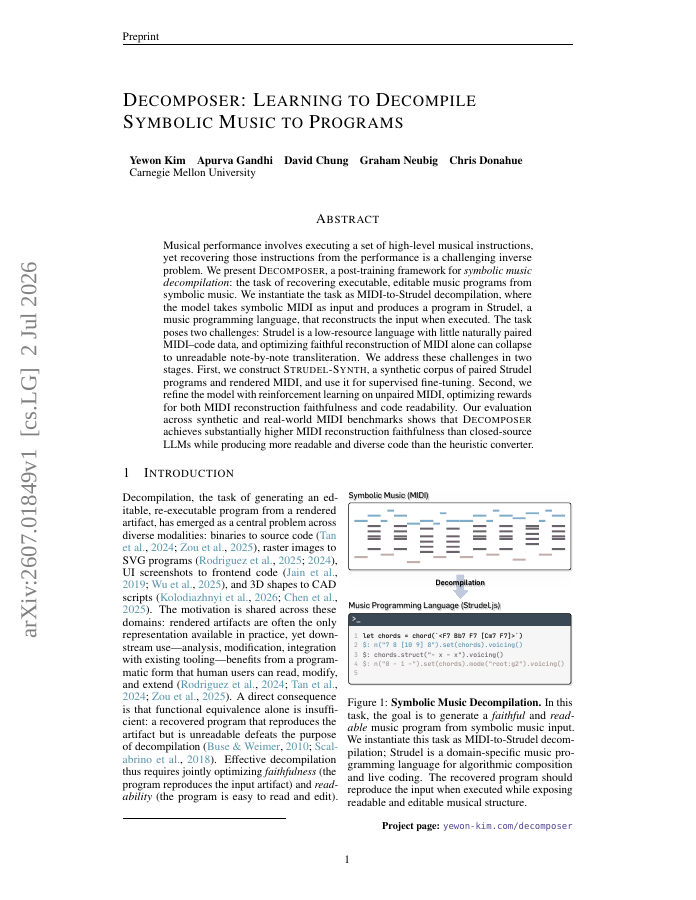
Musical performance involves executing a set of high-level musical instructions, yet recovering those instructions from the performance is a challenging inverse problem. We present Decomposer, a post-training framework for symbolic music decompilation: the task of recovering executable, editable music programs from symbolic music. We instantiate the task as MIDI-to-Strudel decompilation, where the model takes symbolic MIDI as input and produces a program in Strudel, a music programming language, that reconstructs the input when executed. The task poses two challenges: Strudel is a low-resource language with little naturally paired MIDI-code data, and optimizing faithful reconstruction of MIDI alone can collapse to unreadable note-by-note transliteration. We address these challenges in two stages. First, we construct Strudel-Synth, a synthetic corpus of paired Strudel programs and rendered MIDI, and use it for supervised fine-tuning. Second, we refine the model with reinforcement learning on unpaired MIDI, optimizing rewards for both MIDI reconstruction faithfulness and code readability. Our evaluation across synthetic and real-world MIDI benchmarks shows that Decomposer achieves substantially higher MIDI reconstruction faithfulness than closed-source LLMs while producing more readable and diverse code than the heuristic converter.
Decomposer: Learning to Decompile Symbolic Music to Programs
Musical performance involves executing a set of high-level musical instructions, yet recovering those instructions from the performance is a challenging inverse problem.
- Preview
- Year
- 2026
- Hosting
- Full text hostedCC-BY-4.0
Cite
Notes
Only stored in your browser.
Attribution
- Abstract & full text
- arxiv.org/abs/2607.01849CC-BY-4.0
- TL;DR
- Semantic Scholar