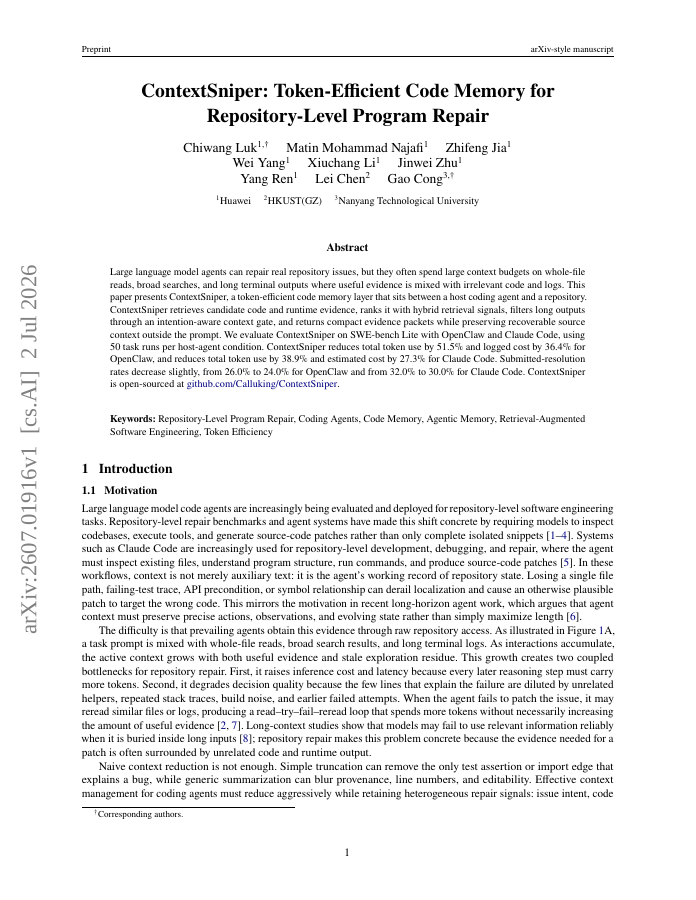
Large language model agents can repair real repository issues, but they often spend large context budgets on whole-file reads, broad searches, and long terminal outputs where useful evidence is mixed with irrelevant code and logs. This paper presents ContextSniper, AntTrail's token-efficient code memory layer for repository-level program repair. As the coding specialization of AntTrail's broader agent memory engine, ContextSniper implements the Sniper feature for precision evidence selection: it retrieves candidate code and runtime evidence, ranks it with hybrid retrieval signals, filters long outputs through an intention-aware context gate, and returns compact evidence packets while preserving recoverable source context outside the prompt. We evaluate ContextSniper on SWE-bench Lite with OpenClaw and Claude Code, using 50 task runs per host-agent condition. ContextSniper reduces total token use by 51.5% and logged cost by 36.4% for OpenClaw, and reduces total token use by 38.9% and estimated cost by 27.3% for Claude Code. Submitted-resolution rates decrease slightly, from 26.0% to 24.0% for OpenClaw and from 32.0% to 30.0% for Claude Code. ContextSniper's pilot testing scripts are open-sourced at https://github.com/Calluking/ContextSniper
ContextSniper: AntTrail's Token-Efficient Code Memory for Repository-Level Program Repair
Large language model agents can repair real repository issues, but they often spend large context budgets on whole-file reads, broad searches, and long terminal outputs where useful evidence is mixed with irrelevant code and logs.
- Preview
- Year
- 2026
- Hosting
- Abstract onlyARXIV-DEFAULT
Cite
Notes
Only stored in your browser.
Attribution
- Abstract & full text
- arxiv.org/abs/2607.01916ARXIV-DEFAULT
- TL;DR
- Semantic Scholar