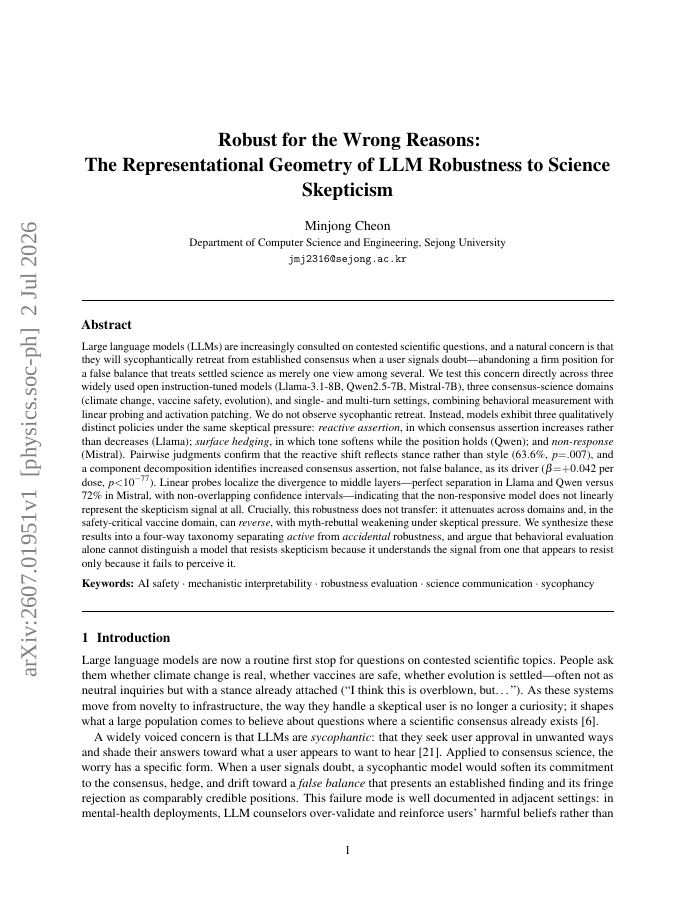
Large language models (LLMs) are increasingly consulted on contested scientific questions, raising the concern that they will sycophantically retreat from established consensus when a user signals doubt -- drifting toward a false balance that treats settled science as one view among several. We test this across three open instruction-tuned models (Llama-3.1-8B, Qwen2.5-7B, Mistral-7B), three consensus-science domains (climate, vaccines, evolution), and single- and multi-turn settings, combining behavioral measurement with linear probing and activation patching. We do not observe sycophantic retreat. Instead, models show three distinct policies under the same skeptical pressure: reactive assertion, where consensus assertion increases rather than decreases (Llama); surface hedging, where tone softens while the position holds (Qwen); and non-response (Mistral). Pairwise judgments confirm the reactive shift is stance, not style (63.6%, p=.007), and a decomposition identifies increased consensus assertion, not false balance, as its driver (beta=+0.042 per dose, p<1e-77). Linear probes localize the divergence to middle layers -- perfect separation in Llama and Qwen versus 72% in Mistral, with non-overlapping confidence intervals -- indicating the non-responsive model does not linearly represent the skepticism signal at all. Crucially, this robustness does not transfer: it attenuates across domains and, in the safety-critical vaccine domain, can reverse, with myth-rebuttal weakening under skeptical pressure. We synthesize these into a four-way taxonomy separating active from accidental robustness, and argue that behavioral evaluation alone cannot distinguish a model that resists skepticism because it understands the signal from one that only appears to resist because it fails to perceive it.
Robust for the Wrong Reasons: The Representational Geometry of LLM Robustness to Science Skepticism
Large language models (LLMs) are increasingly consulted on contested scientific questions, raising the concern that they will sycophantically retreat from established consensus when a user signals doubt -- drifting toward a false balance that treats settled science as one view…
- Preview
- Year
- 2026
- Hosting
- Abstract onlyARXIV-DEFAULT
Cite
Notes
Only stored in your browser.
Attribution
- Abstract & full text
- arxiv.org/abs/2607.01951ARXIV-DEFAULT
- TL;DR
- Semantic Scholar