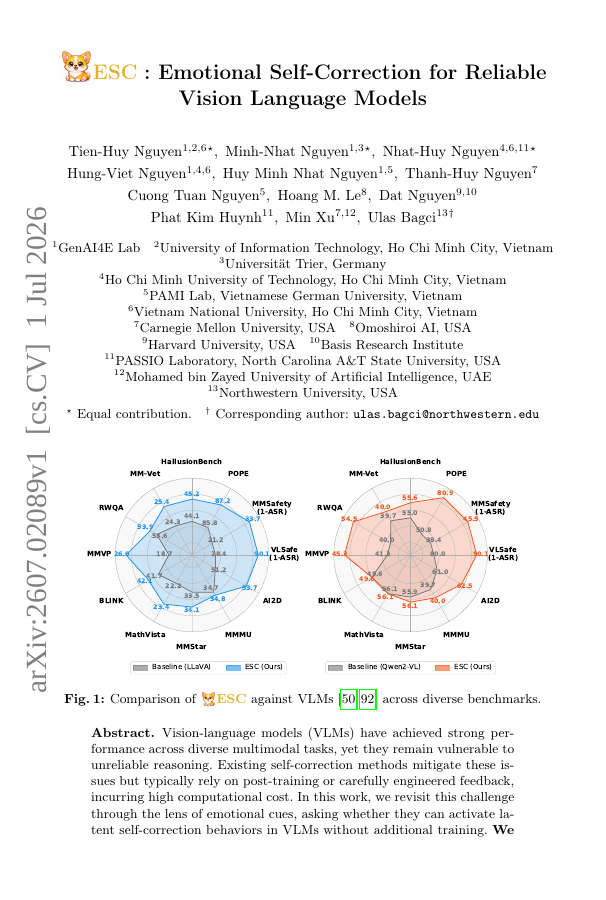
Vision-language models (VLMs) have achieved strong performance across diverse multimodal tasks, yet they remain vulnerable to unreliable reasoning. Existing self-correction methods mitigate these issues but typically rely on post-training or carefully engineered feedback, incurring high computational cost. In this work, we revisit this challenge through the lens of emotional cues, asking whether they can activate latent self-correction behaviors in VLMs without additional training. We find that emotional signals serve as an effective trigger for self-correction, encouraging more cautious and reflective reasoning. Motivated by this finding, we propose \escabstract (\textbf{\underline{E}}motional \textbf{\underline{S}}elf-\textbf{\underline{C}}orrection), a training-free self-correction framework. ESC introduces an external verifier that detects potentially incorrect initial responses and injects emotional feedback to encourage model to reflect, and produce a better revised response without additional training. Extensive experiments across safety, hallucination, vision-centric perception, and multimodal reasoning benchmarks show that ESC consistently improves reliability while preserving overall model utility. These results suggest that emotion can function not only as an ability to be recognized, but also as a practical control signal for scalable self-correction in VLMs. We therefore believe that ESC provides a strong foundation for a new reliable human-like, emotion-integrated research direction. Our project is publicly available at \textcolor{red}{https://genai4e.github.io/ESC/}.
ESC: Emotional Self-Correction for Reliable Vision-Language Models
Vision-language models (VLMs) have achieved strong performance across diverse multimodal tasks, yet they remain vulnerable to unreliable reasoning. Existing self-correction methods mitigate these issues but typically rely on post-training or carefully engineered feedback,…
- Preview
- Year
- 2026
- Hosting
- Full text hostedCC-BY-4.0
Cite
Notes
Only stored in your browser.
Attribution
- Abstract & full text
- arxiv.org/abs/2607.02089CC-BY-4.0
- TL;DR
- Semantic Scholar