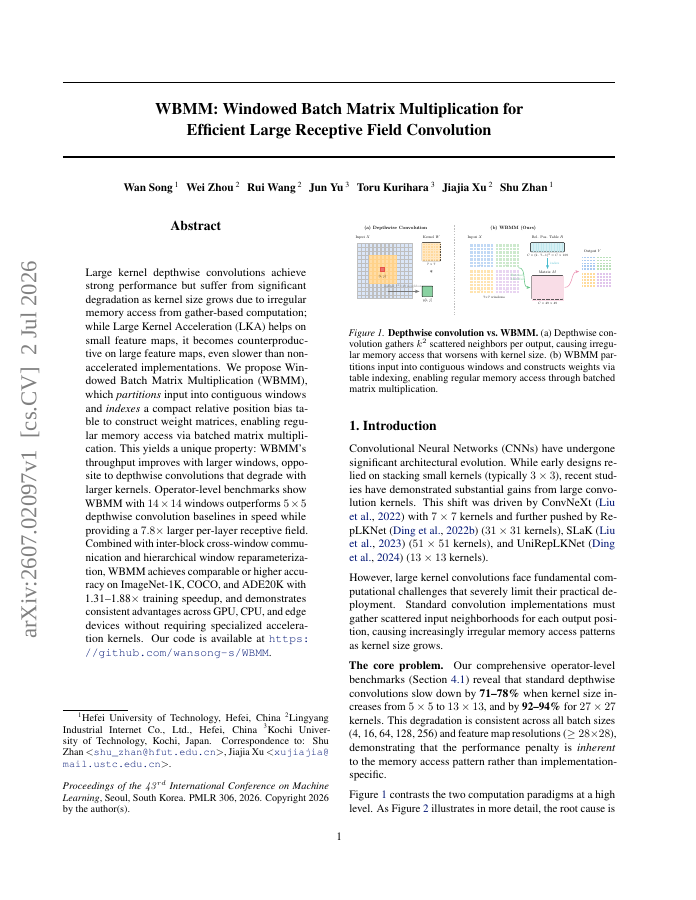
Large kernel depthwise convolutions achieve strong performance but suffer from significant degradation as kernel size grows due to irregular memory access from gather-based computation; while Large Kernel Acceleration (LKA) helps on small feature maps, it becomes counterproductive on large feature maps, even slower than non-accelerated implementations. We propose Windowed Batch Matrix Multiplication (WBMM), which partitions input into contiguous windows and indexes a compact relative position bias table to construct weight matrices, enabling regular memory access via batched matrix multiplication. This yields a unique property: WBMM's throughput improves with larger windows, opposite to depthwise convolutions that degrade with larger kernels. Operator-level benchmarks show WBMM with 14x14 windows outperforms 5x5 depthwise convolution baselines in speed while providing a 7.8x larger per-layer receptive field. Combined with inter-block cross-window communication and hierarchical window reparameterization, WBMM achieves comparable or higher accuracy on ImageNet-1K, COCO, and ADE20K with 1.31-1.88x training speedup, and demonstrates consistent advantages across GPU, CPU, and edge devices without requiring specialized acceleration kernels. Our code is available at http://github.com/wansong-s/WBMM
WBMM: Windowed Batch Matrix Multiplication for Efficient Large Receptive Field Convolution
Large kernel depthwise convolutions achieve strong performance but suffer from significant degradation as kernel size grows due to irregular memory access from gather-based computation; while Large Kernel Acceleration (LKA) helps on small feature maps, it becomes…
- Preview
- Year
- 2026
- Hosting
- Abstract onlyARXIV-DEFAULT
Cite
Notes
Only stored in your browser.
Attribution
- Abstract & full text
- arxiv.org/abs/2607.02097ARXIV-DEFAULT
- TL;DR
- Semantic Scholar