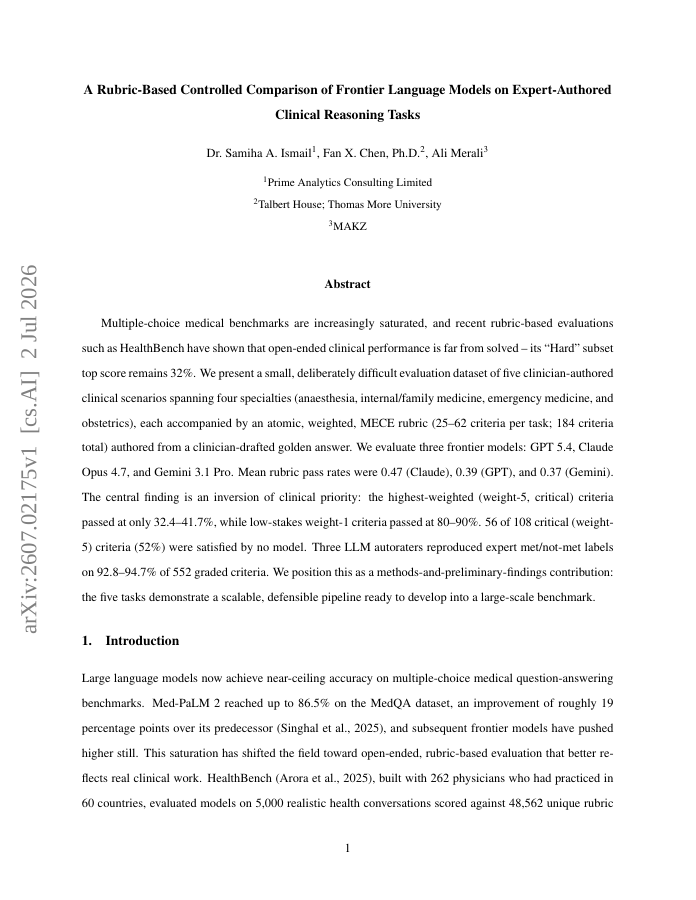
Multiple-choice medical benchmarks are increasingly saturated, and recent rubric-based evaluations such as HealthBench have shown that open-ended clinical performance is far from solved - its "Hard" subset top score remains 32%. We present a small, deliberately difficult evaluation dataset of five clinician-authored clinical scenarios spanning four specialties (anaesthesia, internal/family medicine, emergency medicine, and obstetrics), each accompanied by an atomic, weighted, MECE rubric (25-62 criteria per task; 184 criteria total) authored from a clinician-drafted golden answer. We evaluate three frontier models: GPT 5.4, Claude Opus 4.7, and Gemini 3.1 Pro. Mean rubric pass rates were 0.47 (Claude), 0.39 (GPT), and 0.37 (Gemini). The central finding is an inversion of clinical priority: the highest-weighted (weight-5, critical) criteria passed at only 32.4-41.7%, while low-stakes weight-1 criteria passed at 80-90%. 56 of 108 critical (weight-5) criteria (52%) were satisfied by no model. Three LLM autoraters reproduced expert met/not-met labels on 92.8-94.7% of 552 graded criteria. We position this as a methods-and-preliminary-findings contribution: the five tasks demonstrate a scalable, defensible pipeline ready to develop into a large-scale benchmark.
A rubric-based controlled comparison of frontier language models on expert-authored clinical reasoning tasks
Multiple-choice medical benchmarks are increasingly saturated, and recent rubric-based evaluations such as HealthBench have shown that open-ended clinical performance is far from solved - its "Hard" subset top score remains 32%.
- Preview
- Year
- 2026
- Hosting
- Full text hostedCC-BY-4.0
Cite
Notes
Only stored in your browser.
Attribution
- Abstract & full text
- arxiv.org/abs/2607.02175CC-BY-4.0
- TL;DR
- Semantic Scholar