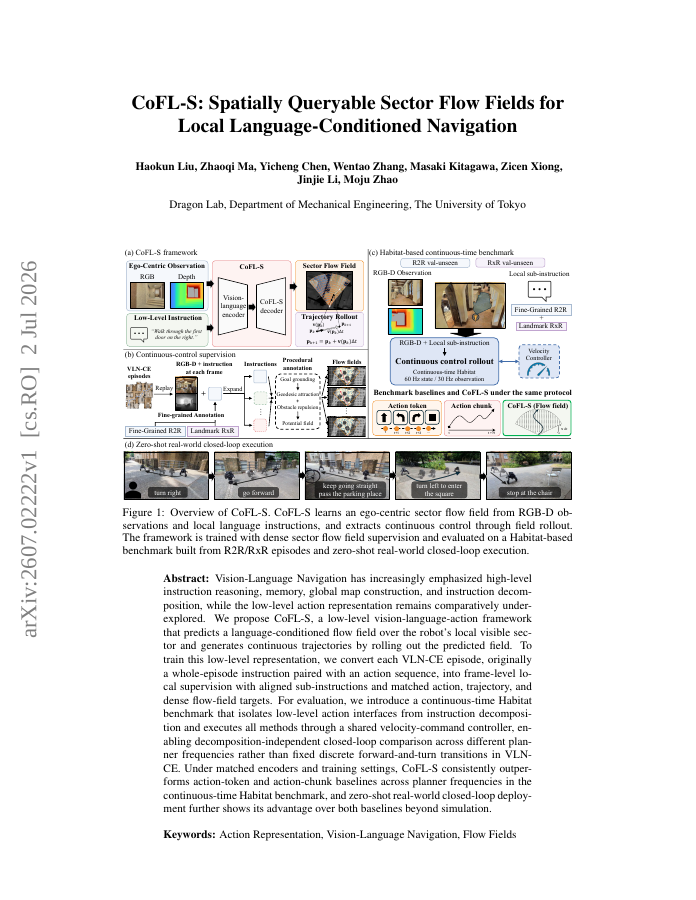
Vision-Language Navigation has increasingly emphasized high-level instruction reasoning, memory, global map construction, and instruction decomposition, while the low-level action representation remains comparatively underexplored. We propose CoFL-S, a low-level vision-language-action framework that predicts a language-conditioned flow field over the robot's local visible sector and generates continuous trajectories by rolling out the predicted field. To train this low-level representation, we convert each VLN-CE episode, originally a whole-episode instruction paired with an action sequence, into frame-level local supervision with aligned sub-instructions and matched action, trajectory, and dense flow-field targets. For evaluation, we introduce a continuous-time Habitat benchmark that isolates low-level action interfaces from instruction decomposition and executes all methods through a shared velocity-command controller, enabling decomposition-independent closed-loop comparison across different planner frequencies rather than fixed discrete forward-and-turn transitions in VLN-CE. Under matched encoders and training settings, CoFL-S consistently outperforms action-token and action-chunk baselines across planner frequencies in the continuous-time Habitat benchmark, and zero-shot real-world closed-loop deployment further shows its advantage over both baselines beyond simulation.
CoFL-S: Spatially Queryable Sector Flow Fields for Local Language-Conditioned Navigation
Vision-Language Navigation has increasingly emphasized high-level instruction reasoning, memory, global map construction, and instruction decomposition, while the low-level action representation remains comparatively underexplored.
- Preview
- Year
- 2026
- Hosting
- Full text hostedCC-BY-4.0
Cite
Notes
Only stored in your browser.
Attribution
- Abstract & full text
- arxiv.org/abs/2607.02222CC-BY-4.0
- TL;DR
- Semantic Scholar