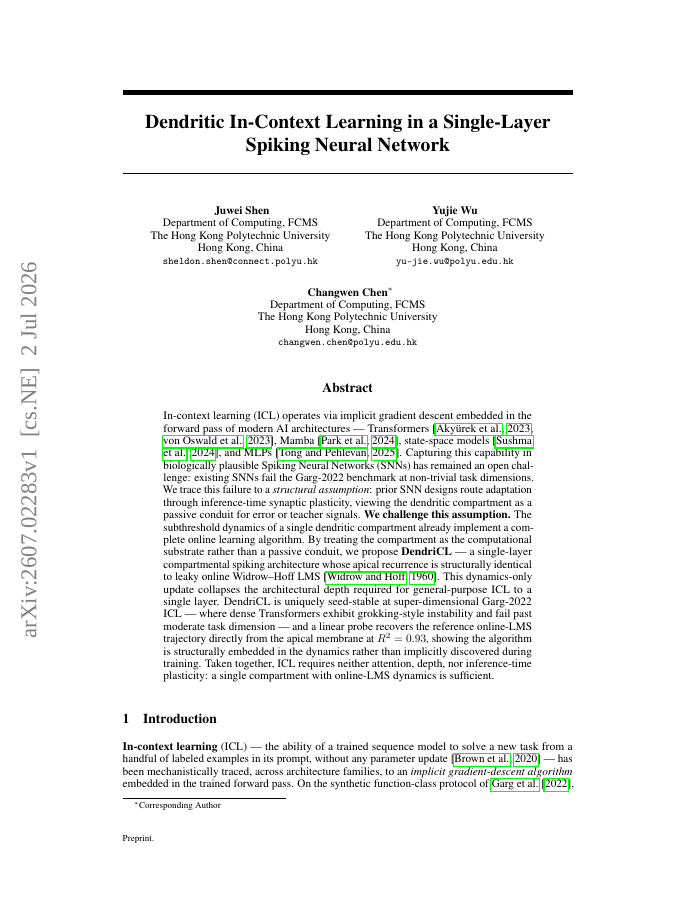
In-context learning (ICL) operates via implicit gradient descent embedded in the forward pass of modern AI architectures -- Transformers, Mamba, state-space models, and MLPs. Capturing this capability in biologically plausible Spiking Neural Networks (SNNs) has remained an open challenge: existing SNNs fail the Garg-2022 benchmark at non-trivial task dimensions. We trace this failure to a structural assumption: prior SNN designs route adaptation through inference-time synaptic plasticity, viewing the dendritic compartment as a passive conduit for error or teacher signals. We challenge this assumption. The subthreshold dynamics of a single dendritic compartment already implement a complete online learning algorithm. By treating the compartment as the computational substrate rather than a passive conduit, we propose DendriCL -- a single-layer compartmental spiking architecture whose apical recurrence is structurally identical to leaky online Widrow-Hoff LMS. This dynamics-only update collapses the architectural depth required for general-purpose ICL to a single layer. DendriCL is uniquely seed-stable at super-dimensional Garg-2022 ICL -- where dense Transformers exhibit grokking-style instability and fail past moderate task dimension -- and a linear probe recovers the reference online-LMS trajectory directly from the apical membrane at R^2 = 0.93, showing the algorithm is structurally embedded in the dynamics rather than implicitly discovered during training. Taken together, ICL requires neither attention, depth, nor inference-time plasticity: a single compartment with online-LMS dynamics is sufficient.
Dendritic In-Context Learning in a Single-Layer Spiking Neural Network
In-context learning (ICL) operates via implicit gradient descent embedded in the forward pass of modern AI architectures -- Transformers, Mamba, state-space models, and MLPs.
- Preview
- Year
- 2026
- Hosting
- Abstract onlyARXIV-DEFAULT
Cite
Notes
Only stored in your browser.
Attribution
- Abstract & full text
- arxiv.org/abs/2607.02283ARXIV-DEFAULT
- TL;DR
- Semantic Scholar