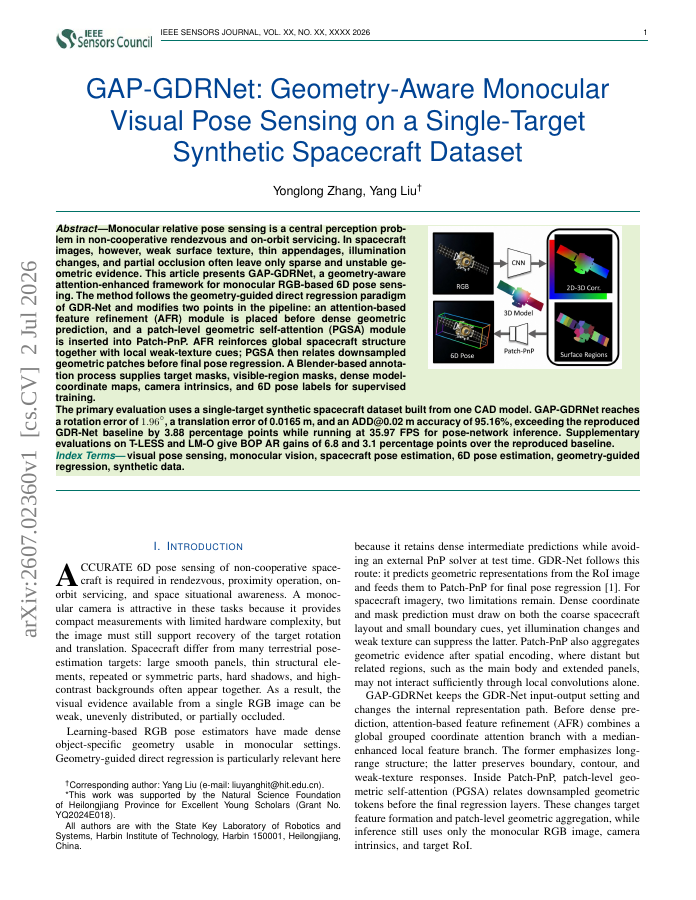
Monocular relative pose sensing is a central perception problem in non-cooperative rendezvous and on-orbit servicing. In spacecraft images, however, weak surface texture, thin appendages, illumination changes, and partial occlusion often leave only sparse and unstable geometric evidence. This article presents GAP-GDRNet, a geometry-aware attention-enhanced framework for monocular RGB-based 6D pose sensing. The method follows the geometry-guided direct regression paradigm of GDR-Net and modifies two points in the pipeline: an attention-based feature refinement (AFR) module is placed before dense geometric prediction, and a patch-level geometric self-attention (PGSA) module is inserted into Patch-PnP. AFR reinforces global spacecraft structure together with local weak-texture cues; PGSA then relates downsampled geometric patches before final pose regression. A Blender-based annotation process supplies target masks, visible-region masks, dense model-coordinate maps, camera intrinsics, and 6D pose labels for supervised training.
GAP-GDRNet: Geometry-Aware Monocular Visual Pose Sensing on a Single-Target Synthetic Spacecraft Dataset
Monocular relative pose sensing is a central perception problem in non-cooperative rendezvous and on-orbit servicing. In spacecraft images, however, weak surface texture, thin appendages, illumination changes, and partial occlusion often leave only sparse and unstable geometric…
- Preview
- Year
- 2026
- Hosting
- Abstract onlyARXIV-DEFAULT
Cite
Notes
Only stored in your browser.
Attribution
- Abstract & full text
- arxiv.org/abs/2607.02360ARXIV-DEFAULT
- TL;DR
- Semantic Scholar