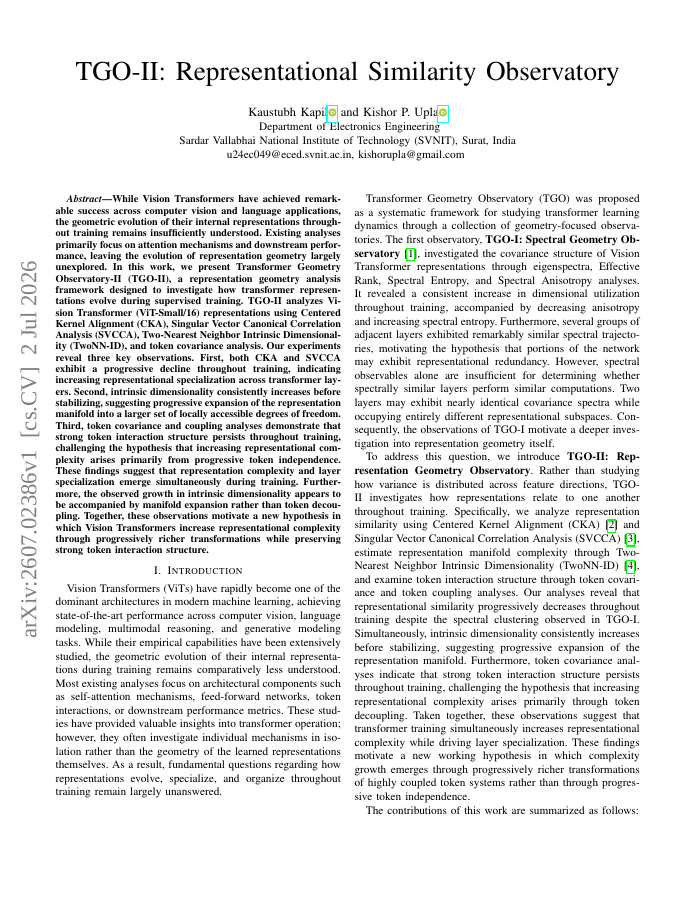
While Vision Transformers have achieved remarkable success across computer vision and language applications, the geometric evolution of their internal representations throughout training remains insufficiently understood. Existing analyses primarily focus on attention mechanisms and downstream performance, leaving the evolution of representation geometry largely unexplored. In this work, we present Transformer Geometry Observatory-II (TGO-II), a representation geometry analysis framework designed to investigate how Transformer representations evolve during supervised training. TGO-II analyzes Vision Transformer (ViT-Small/16) representations using Centered Kernel Alignment (CKA), Singular Vector Canonical Correlation Analysis (SVCCA), Two-Nearest Neighbor Intrinsic Dimensionality (TwoNN-ID), and token covariance analysis. Our experiments reveal three key observations. First, both CKA and SVCCA progressively decrease throughout training, indicating increasing representational specialization across Transformer layers. Second, intrinsic dimensionality consistently increases before stabilizing, suggesting progressive expansion of the representation manifold into a larger set of locally accessible degrees of freedom. Third, token covariance and coupling analyses demonstrate that strong token interaction structure persists throughout training, challenging the hypothesis that increasing representational complexity arises primarily from progressive token independence. These findings suggest that representation complexity and layer specialization emerge simultaneously during training. Manifold expansion appears to occur without token decoupling. Together, these observations motivate a new hypothesis in which Vision Transformers increase representational complexity through progressively richer transformations while preserving strong token interaction structure during learning.
Transformer Geometry Observatory TGO-II: Representational Similarity Observatory
While Vision Transformers have achieved remarkable success across computer vision and language applications, the geometric evolution of their internal representations throughout training remains insufficiently understood.
- Preview
- Year
- 2026
- Hosting
- Full text hostedCC-BY-4.0
Cite
Notes
Only stored in your browser.
Attribution
- Abstract & full text
- arxiv.org/abs/2607.02386CC-BY-4.0
- TL;DR
- Semantic Scholar