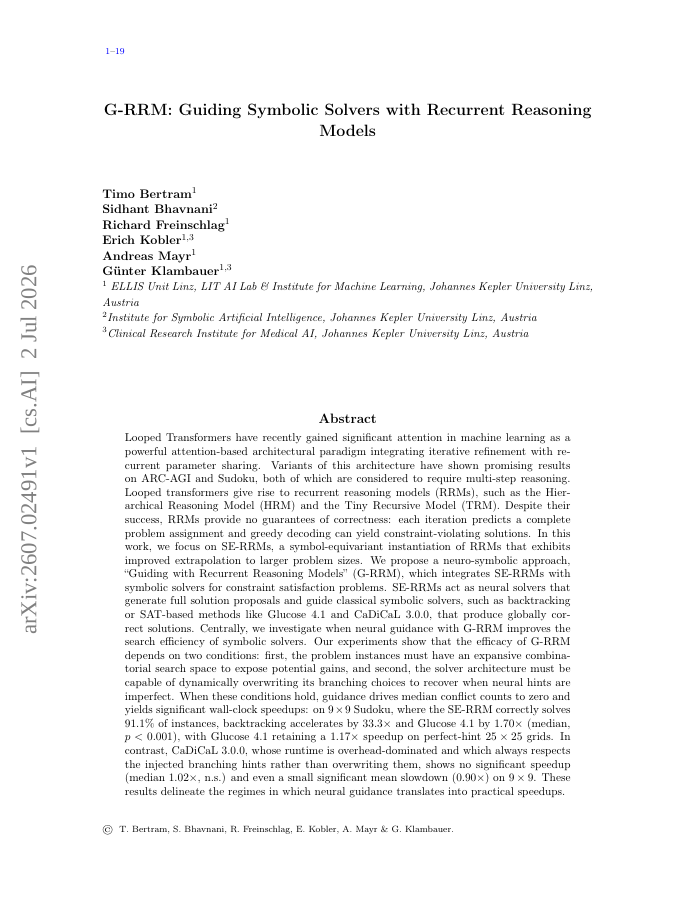
In this work, we focus on SE-RRMs, a symbol-equivariant instantiation of RRMs that exhibits improved extrapolation to larger problem sizes. We propose a neuro-symbolic approach, ``Guiding with Recurrent Reasoning Models'' (G-RRM), which integrates SE-RRMs with symbolic solvers for constraint satisfaction problems. SE-RRMs act as neural solvers that generate full solution proposals and guide classical symbolic solvers, such as backtracking or SAT-based methods like Glucose 4.1 and CaDiCaL 3.0.0, that produce globally correct solutions. Centrally, we investigate when neural guidance with G-RRM improves the search efficiency of symbolic solvers. % Our experiments show that the efficacy of G-RRM depends on two conditions: first, the problem instances must have an expansive combinatorial search space to expose potential gains, and second, the solver architecture must be capable of dynamically overwriting its branching choices to recover when neural hints are imperfect. When these conditions hold, guidance drives median conflict counts to zero and yields significant wall-clock speedups: on 9\times9 Sudoku, where the SE-RRM correctly solves 91.1% of instances, backtracking accelerates by 33.3\times and Glucose 4.1 by 1.70\times (median, p<0.001), with Glucose 4.1 retaining a 1.17\times speedup on perfect-hint 25\times25 grids. In contrast, CaDiCaL 3.0.0, whose runtime is overhead-dominated and which always respects the injected branching hints rather than overwriting them, shows no significant speedup (median 1.02\times, n.s.) and even a small significant mean slowdown (0.90\times) on 9\times9. These results delineate the regimes in which neural guidance translates into practical speedups.
G-RRM: Guiding Symbolic Solvers with Recurrent Reasoning Models
In this work, we focus on SE-RRMs, a symbol-equivariant instantiation of RRMs that exhibits improved extrapolation to larger problem sizes. We propose a neuro-symbolic approach, ``Guiding with Recurrent Reasoning Models'' (G-RRM), which integrates SE-RRMs with symbolic solvers…
- Preview
- Year
- 2026
- Hosting
- Full text hostedCC-BY-4.0
Cite
Notes
Only stored in your browser.
Attribution
- Abstract & full text
- arxiv.org/abs/2607.02491CC-BY-4.0
- TL;DR
- Semantic Scholar