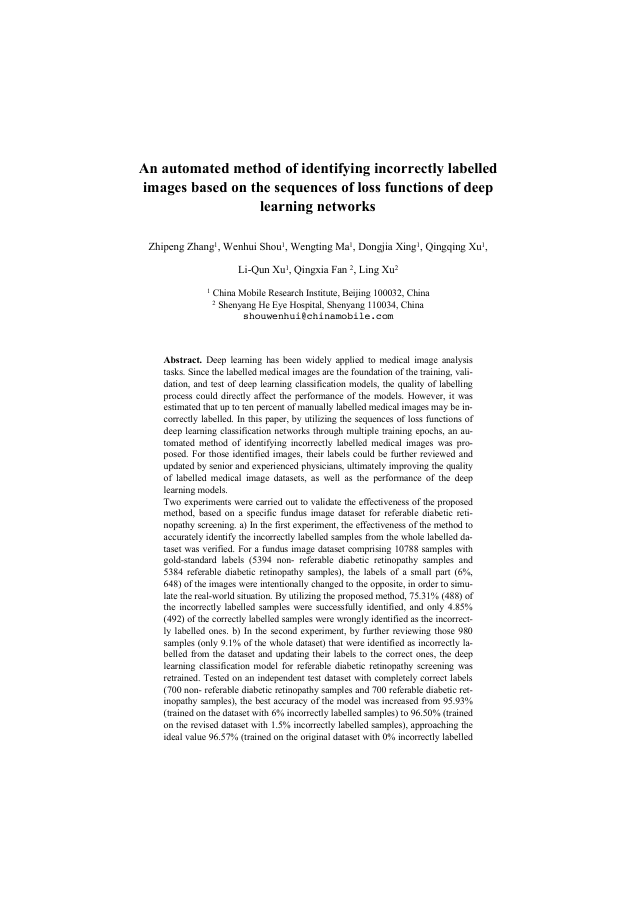
Deep learning is widely applied in medical image analysis, but up to 10% of manually labelled images may be incorrect, degrading model performance. This paper proposes an automated method to identify incorrectly labelled medical images by analyzing sequences of loss functions from deep learning classification networks over multiple training epochs. Identified images can be reviewed and relabelled by experts, improving dataset quality and model performance. Two experiments validate the method on a fundus image dataset for referable diabetic retinopathy screening. In the first, 6% (648) of 10,788 gold-standard labels were intentionally flipped. The method identified 75.31% (488) of the flipped samples, with only 4.85% (492) false positives among correctly labelled samples. In the second, reviewing and correcting the 980 identified samples (9.1% of the dataset) and retraining the model improved best accuracy on an independent test set from 95.93% (with 6% label noise) to 96.50% (with 1.5% noise), approaching the ideal 96.57% (with 0% noise). The results demonstrate the method's effectiveness in improving model performance through automated label quality control.
An automated method of identifying incorrectly labelled images based on the sequences of loss functions of deep learning networks
Deep learning is widely applied in medical image analysis, but up to 10% of manually labelled images may be incorrect, degrading model performance. This paper proposes an automated method to identify incorrectly labelled medical images by analyzing sequences of loss functions…
- Preview
- Year
- 2026
- Hosting
- Full text hostedCC-BY-4.0
Cite
Notes
Only stored in your browser.
Attribution
- Abstract & full text
- arxiv.org/abs/2607.02594CC-BY-4.0
- TL;DR
- Semantic Scholar