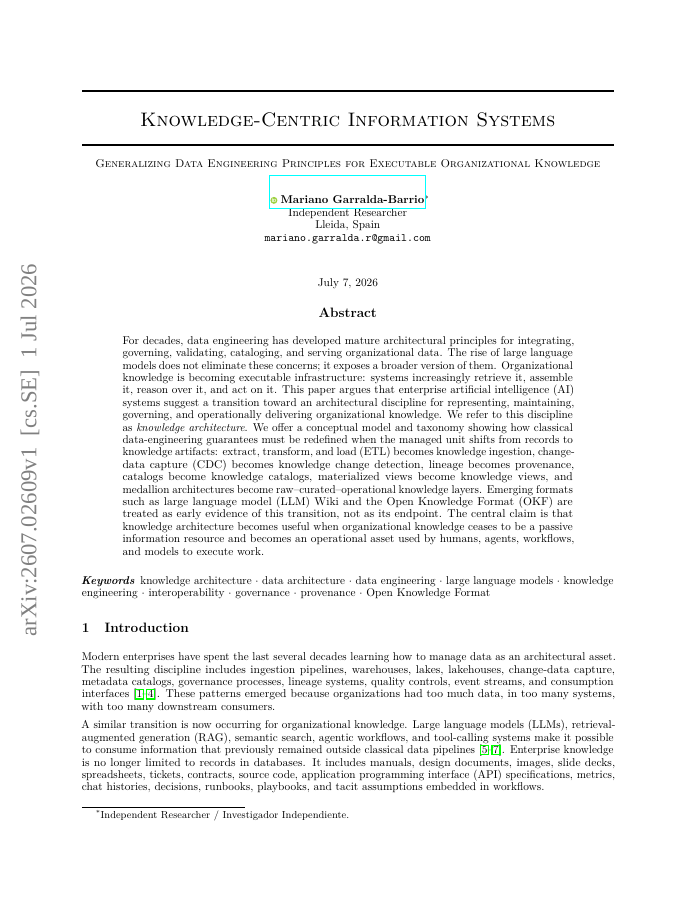
For decades, data engineering has developed mature architectural principles for integrating, governing, validating, cataloging, and serving organizational data. The rise of large language models does not eliminate these concerns; it exposes a broader version of them. Organizational knowledge is becoming executable infrastructure: systems increasingly retrieve it, assemble it, reason over it, and act on it. This paper argues that enterprise artificial intelligence (AI) systems suggest a transition toward an architectural discipline for representing, maintaining, governing, and operationally delivering organizational knowledge. We refer to this discipline as knowledge architecture. We offer a conceptual model and taxonomy showing how classical data-engineering guarantees must be redefined when the managed unit shifts from records to knowledge artifacts: extract, transform, and load (ETL) becomes knowledge ingestion, change-data capture (CDC) becomes knowledge change detection, lineage becomes provenance, catalogs become knowledge catalogs, materialized views become knowledge views, and medallion architectures become raw--curated--operational knowledge layers. Emerging formats such as large language model (LLM) Wiki and the Open Knowledge Format (OKF) are treated as early evidence of this transition, not as its endpoint. The central claim is that knowledge architecture becomes useful when organizational knowledge ceases to be a passive information resource and becomes an operational asset used by humans, agents, workflows, and models to execute work.
Knowledge-Centric Information Systems
For decades, data engineering has developed mature architectural principles for integrating, governing, validating, cataloging, and serving organizational data. The rise of large language models does not eliminate these concerns; it exposes a broader version of them.
- Preview
- Year
- 2026
- Hosting
- Excerpt onlyCC-BY-NC-SA-4.0
Cite
Notes
Only stored in your browser.
Attribution
- Abstract & full text
- arxiv.org/abs/2607.02609CC-BY-NC-SA-4.0
- TL;DR
- Semantic Scholar