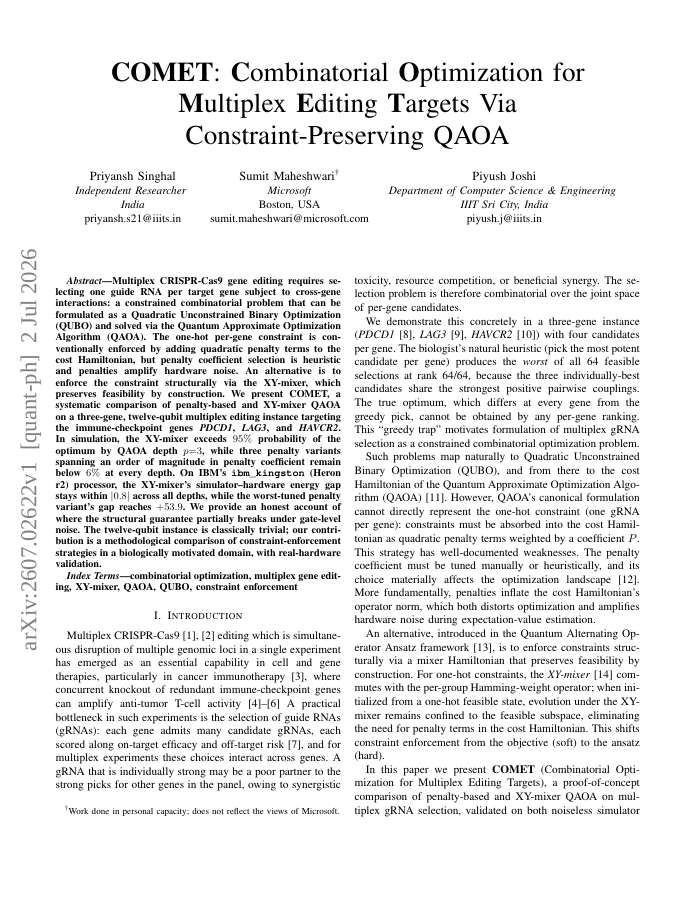
Multiplex CRISPR-Cas9 gene editing requires selecting one guide RNA per target gene subject to cross-gene interactions: a constrained combinatorial problem that can be formulated as a Quadratic Unconstrained Binary Optimization (QUBO) and solved via the Quantum Approximate Optimization Algorithm (QAOA). The one-hot per-gene constraint is conventionally enforced by adding quadratic penalty terms to the cost Hamiltonian, but penalty coefficient selection is heuristic and penalties amplify hardware noise. An alternative is to enforce the constraint structurally via the XY-mixer, which preserves feasibility by construction. We present COMET, a systematic comparison of penalty-based and XY-mixer QAOA on a three-gene, twelve-qubit multiplex editing instance targeting the immune-checkpoint genes PDCD1, LAG3, and HAVCR2. In simulation, the XY-mixer exceeds 95% probability of the optimum by QAOA depth p=3, while three penalty variants spanning an order of magnitude in penalty coefficient remain below 6% at every depth. On IBM's ibm_kingston (Heron r2) processor, the XY-mixer's simulator-hardware energy gap stays within |0.8| across all depths, while the worst-tuned penalty variant's gap reaches +53.9. We provide an honest account of where the structural guarantee partially breaks under gate-level noise. The twelve-qubit instance is classically trivial; our contribution is a methodological comparison of constraint-enforcement strategies in a biologically motivated domain, with real-hardware validation.
COMET: Combinatorial Optimization for Multiplex Editing Targets Via Constraint-Preserving QAOA
Multiplex CRISPR-Cas9 gene editing requires selecting one guide RNA per target gene subject to cross-gene interactions: a constrained combinatorial problem that can be formulated as a Quadratic Unconstrained Binary Optimization (QUBO) and solved via the Quantum Approximate…
- Preview
- Year
- 2026
- Hosting
- Abstract onlyARXIV-DEFAULT
Cite
Notes
Only stored in your browser.
Attribution
- Abstract & full text
- arxiv.org/abs/2607.02622ARXIV-DEFAULT
- TL;DR
- Semantic Scholar