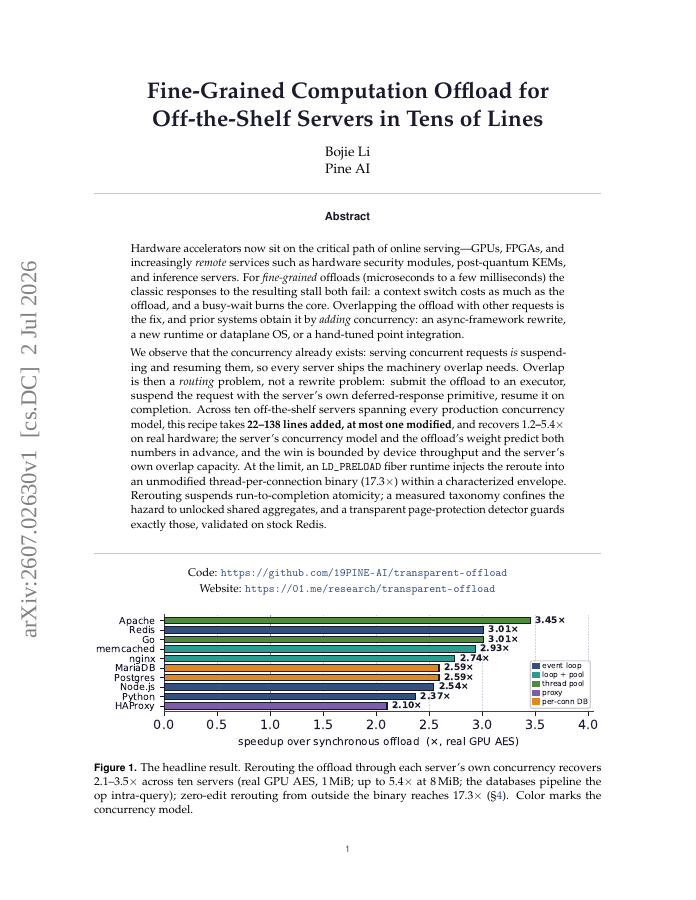
Hardware accelerators now sit on the critical path of online serving. GPUs, FPGAs, and increasingly remote services such as hardware security modules, post-quantum KEMs, and inference servers. For fine-grained offloads (microseconds to a few milliseconds) the classic responses to the resulting stall both fail: a context switch costs as much as the offload, and a busy-wait burns the core. Overlapping the offload with other requests is the fix, and prior systems obtain it by adding concurrency: an async-framework rewrite, a new runtime or dataplane OS, or a hand-tuned point integration. We observe that the concurrency already exists: serving concurrent requests is suspending and resuming them, so every server ships the machinery overlap needs. Overlap is then a routing problem, not a rewrite problem: submit the offload to an executor, suspend the request with the server's own deferred-response primitive, resume it on completion. Across ten off-the-shelf servers spanning every production concurrency model, this recipe takes 22-138 lines added, at most one modified, and recovers 1.2-5.4x on real hardware; the server's concurrency model and the offload's weight predict both numbers in advance, and the win is bounded by device throughput and the server's own overlap capacity. At the limit, an LD_PRELOAD fiber runtime injects the reroute into an unmodified thread-per-connection binary (17.3x) within a characterized envelope. Rerouting suspends run-to-completion atomicity; a measured taxonomy confines the hazard to unlocked shared aggregates, and a transparent page-protection detector guards exactly those, validated on stock Redis.
Fine-Grained Computation Offload for Off-the-Shelf Servers in Tens of Lines
Hardware accelerators now sit on the critical path of online serving. GPUs, FPGAs, and increasingly remote services such as hardware security modules, post-quantum KEMs, and inference servers.
- Preview
- Year
- 2026
- Hosting
- Full text hostedCC-BY-4.0
Cite
Notes
Only stored in your browser.
Attribution
- Abstract & full text
- arxiv.org/abs/2607.02630CC-BY-4.0
- TL;DR
- Semantic Scholar