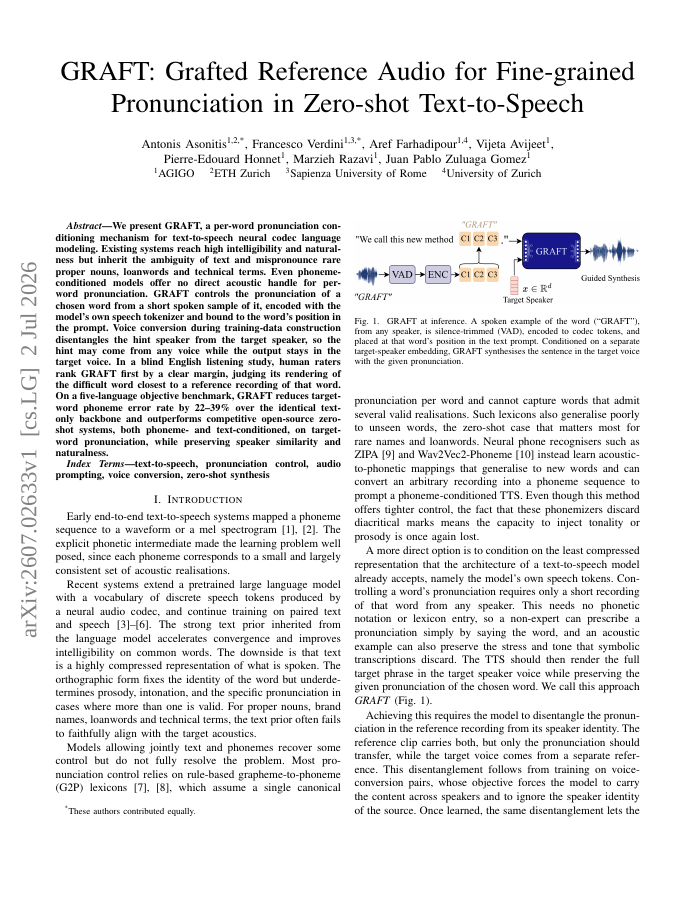
We present GRAFT, a per-word pronunciation conditioning mechanism for text-to-speech neural codec language modeling. Existing systems reach high intelligibility and naturalness but inherit the ambiguity of text and mispronounce rare proper nouns, loanwords and technical terms. Even phoneme-conditioned models offer no direct acoustic handle for per-word pronunciation. GRAFT controls the pronunciation of a chosen word from a short spoken sample of it, encoded with the model's own speech tokenizer and bound to the word's position in the prompt. Voice conversion during training-data construction disentangles the hint speaker from the target speaker, so the hint may come from any voice while the output stays in the target voice. In a blind English listening study, human raters rank GRAFT first by a clear margin, judging its rendering of the difficult word closest to a reference recording of that word. On a five-language objective benchmark, GRAFT reduces target-word phoneme error rate by 22-39% over the identical text-only backbone and outperforms competitive open-source zero-shot systems, both phoneme- and text-conditioned, on target-word pronunciation, while preserving speaker similarity and naturalness.
GRAFT: Grafted Reference Audio for Fine-grained Pronunciation in Zero-shot Text-to-Speech
We present GRAFT, a per-word pronunciation conditioning mechanism for text-to-speech neural codec language modeling. Existing systems reach high intelligibility and naturalness but inherit the ambiguity of text and mispronounce rare proper nouns, loanwords and technical terms.
- Preview
- Year
- 2026
- Hosting
- Full text hostedCC-BY-4.0
Cite
Notes
Only stored in your browser.
Attribution
- Abstract & full text
- arxiv.org/abs/2607.02633CC-BY-4.0
- TL;DR
- Semantic Scholar