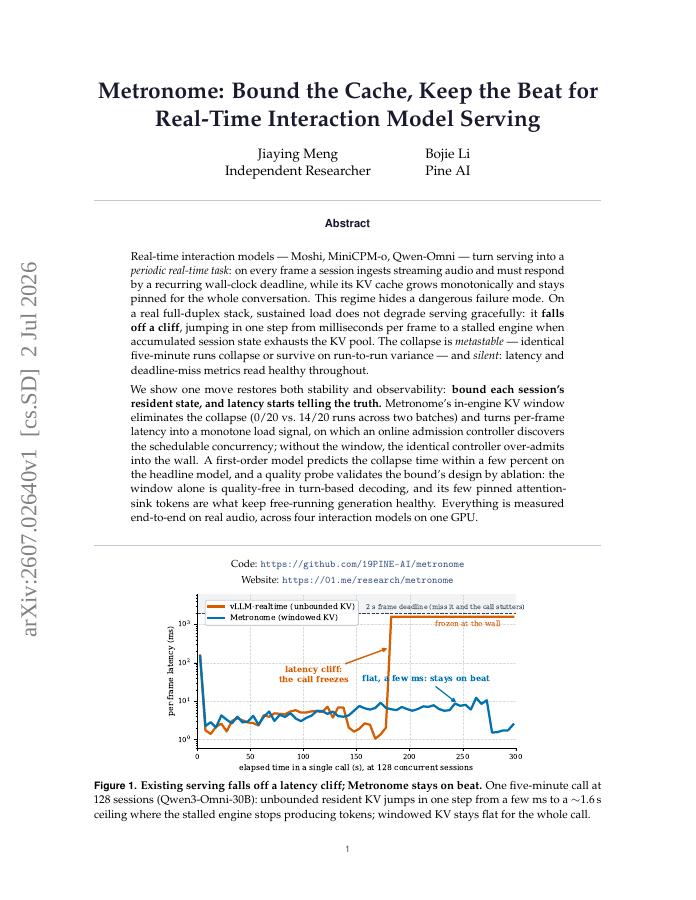
Real-time interaction models -- Moshi, MiniCPM-o, Qwen-Omni -- turn serving into a periodic real-time task: on every frame a session ingests streaming audio and must respond by a recurring wall-clock deadline, while its KV cache grows monotonically and stays pinned for the whole conversation. This regime hides a dangerous failure mode. On a real full-duplex stack, sustained load does not degrade serving gracefully: it falls off a cliff, jumping in one step from milliseconds per frame to a stalled engine when accumulated session state exhausts the KV pool. The collapse is metastable -- identical five-minute runs collapse or survive on run-to-run variance -- and silent: latency and deadline-miss metrics read healthy throughout. We show one move restores both stability and observability: bound each session's resident state, and latency starts telling the truth. Metronome's in-engine KV window eliminates the collapse (0/20 vs. 14/20 runs across two batches) and turns per-frame latency into a monotone load signal, on which an online admission controller discovers the schedulable concurrency; without the window, the identical controller over-admits into the wall. A first-order model predicts the collapse time within a few percent on the headline model, and a quality probe validates the bound's design by ablation: the window alone is quality-free in turn-based decoding, and its few pinned attention-sink tokens are what keep free-running generation healthy. Everything is measured end-to-end on real audio, across four interaction models on one GPU.
Metronome: Bound the Cache, Keep the Beat for Real-Time Interaction Model Serving
Real-time interaction models -- Moshi, MiniCPM-o, Qwen-Omni -- turn serving into a periodic real-time task: on every frame a session ingests streaming audio and must respond by a recurring wall-clock deadline, while its KV cache grows monotonically and stays pinned for the whole…
- Preview
- Year
- 2026
- Hosting
- Full text hostedCC-BY-4.0
Cite
Notes
Only stored in your browser.
Attribution
- Abstract & full text
- arxiv.org/abs/2607.02640CC-BY-4.0
- TL;DR
- Semantic Scholar