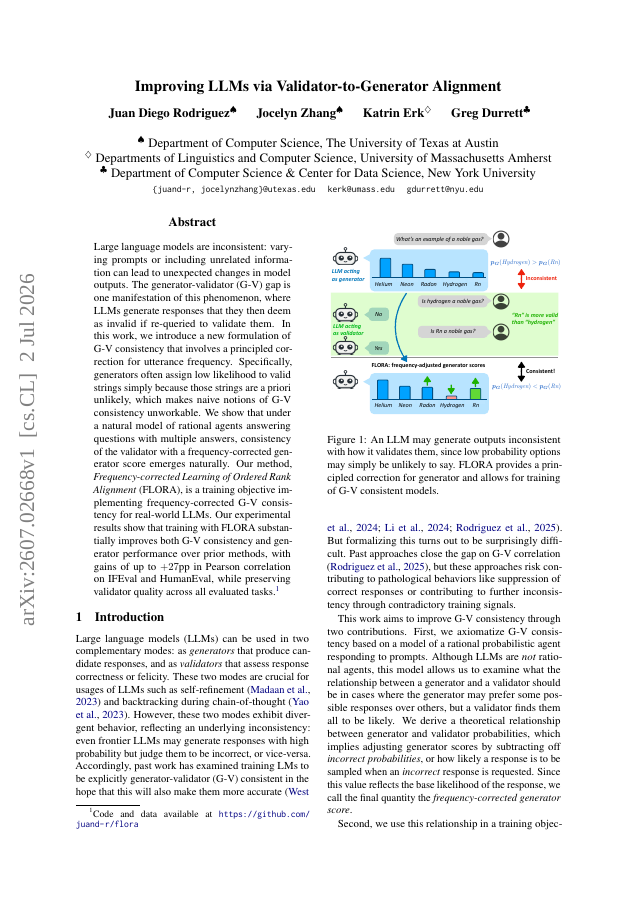
Large language models are inconsistent: varying prompts or including unrelated information can lead to unexpected changes in model outputs. The generator-validator (G-V) gap is one manifestation of this phenomenon, where LLMs generate responses that they then deem as invalid if re-queried to validate them. In this work, we introduce a new formulation of G-V consistency that involves a principled correction for utterance frequency. Specifically, generators often assign low likelihood to valid strings simply because those strings are a priori unlikely, which makes naive notions of G-V consistency unworkable. We show that under a natural model of rational agents answering questions with multiple answers, consistency of the validator with a frequency-corrected generator score emerges naturally. Our method, \FCPAname (\FCPA), is a training objective implementing frequency-corrected G-V consistency for real-world LLMs. Our experimental results show that training with \FCPA{} substantially improves both G-V consistency and generator performance over prior methods, with gains of up to +27pp in Pearson correlation on IFEval and HumanEval, while preserving validator quality across all evaluated tasks.
Improving LLMs via Validator-to-Generator Alignment
Large language models are inconsistent: varying prompts or including unrelated information can lead to unexpected changes in model outputs. The generator-validator (G-V) gap is one manifestation of this phenomenon, where LLMs generate responses that they then deem as invalid if…
- Preview
- Year
- 2026
- Hosting
- Full text hostedCC-BY-4.0
Cite
Notes
Only stored in your browser.
Attribution
- Abstract & full text
- arxiv.org/abs/2607.02668CC-BY-4.0
- TL;DR
- Semantic Scholar