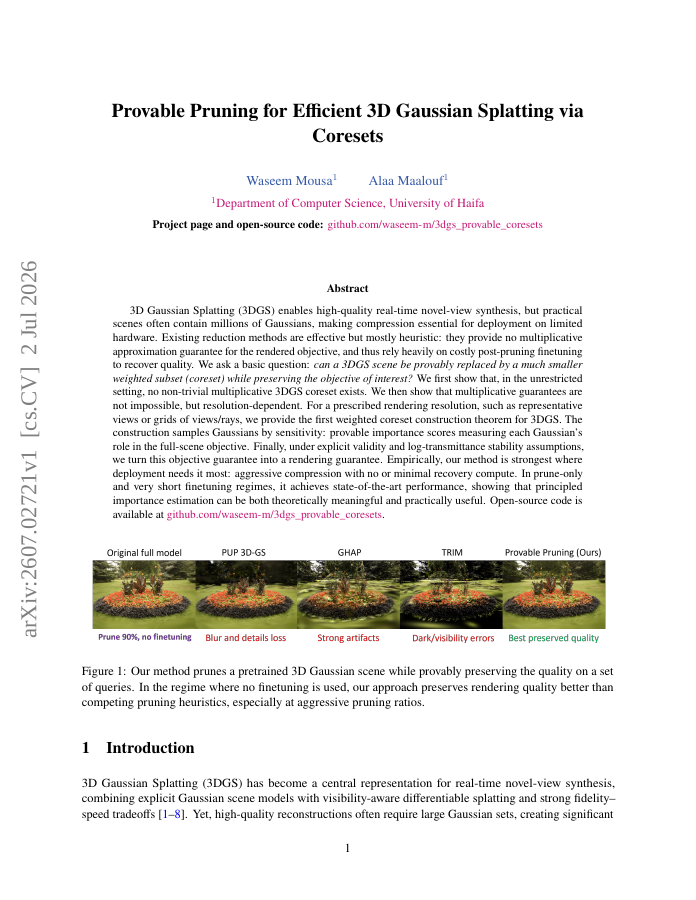
3D Gaussian Splatting (3DGS) enables high-quality real-time novel-view synthesis, but practical scenes often contain millions of Gaussians, making compression essential for deployment on limited hardware. Existing reduction methods are effective but mostly heuristic: they provide no multiplicative approximation guarantee for the rendered objective, and thus rely heavily on costly post-pruning finetuning to recover quality. We ask a basic question: can a 3DGS scene be provably replaced by a much smaller weighted subset (coreset) while preserving the objective of interest? We first show that, in the unrestricted setting, no non-trivial multiplicative 3DGS coreset exists. We then show that multiplicative guarantees are not impossible, but resolution-dependent. For a prescribed rendering resolution, such as representative views or grids of views/rays, we provide the first weighted coreset construction theorem for 3DGS. The construction samples Gaussians by sensitivity: provable importance scores measuring each Gaussian's role in the full-scene objective. Finally, under explicit validity and log-transmittance stability assumptions, we turn this objective guarantee into a rendering guarantee. Empirically, our method is strongest where deployment needs it most: aggressive compression with no or minimal recovery compute. In prune-only and very short finetuning regimes, it achieves state-of-the-art performance, showing that principled importance estimation can be both theoretically meaningful and practically useful. Open-source code is available at https://github.com/waseem-m/3dgs_provable_coresets.
Provable Pruning for Efficient 3D Gaussian Splatting via Coresets
3D Gaussian Splatting (3DGS) enables high-quality real-time novel-view synthesis, but practical scenes often contain millions of Gaussians, making compression essential for deployment on limited hardware.
- Preview
- Year
- 2026
- Hosting
- Full text hostedCC-BY-4.0
Cite
Notes
Only stored in your browser.
Attribution
- Abstract & full text
- arxiv.org/abs/2607.02721CC-BY-4.0
- TL;DR
- Semantic Scholar