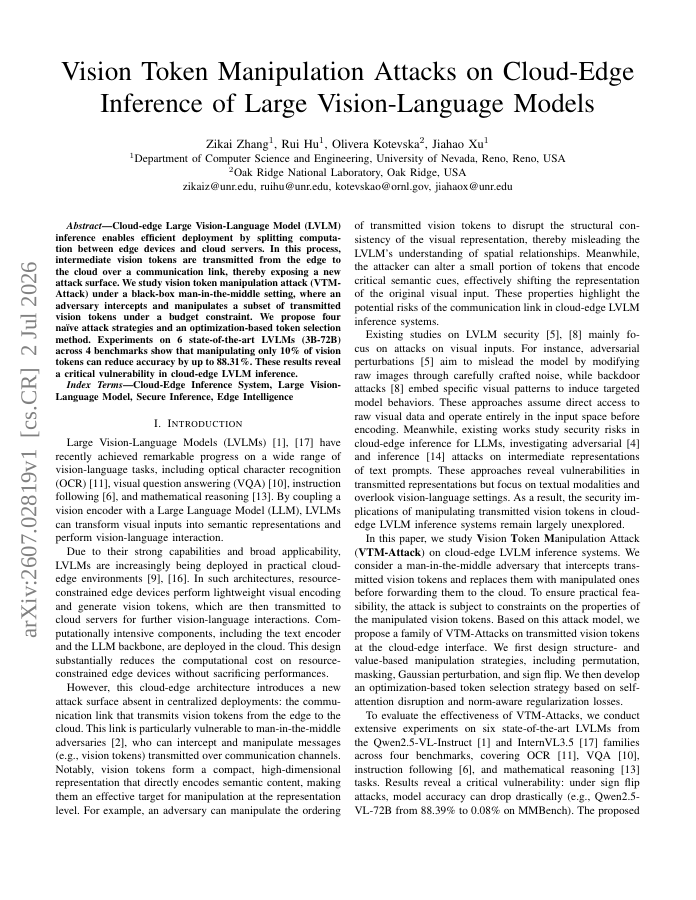
Cloud-edge Large Vision-Language Model (LVLM) inference enables efficient deployment by splitting computation between edge devices and cloud servers. In this process, intermediate vision tokens are transmitted from the edge to the cloud over a communication link, thereby exposing a new attack surface. We study vision token manipulation attack (VTM-Attack) under a black-box man-in-the-middle setting, where an adversary intercepts and manipulates a subset of transmitted vision tokens under a budget constraint. We propose four naïve attack strategies and an optimization-based token selection method. Experiments on 6 state-of-the-art LVLMs (3B-72B) across 4 benchmarks show that manipulating only 10% of vision tokens can reduce accuracy by up to 88.31%. These results reveal a critical vulnerability in cloud-edge LVLM inference.
Vision Token Manipulation Attacks on Cloud-Edge Inference of Large Vision-Language Models
Cloud-edge Large Vision-Language Model (LVLM) inference enables efficient deployment by splitting computation between edge devices and cloud servers. In this process, intermediate vision tokens are transmitted from the edge to the cloud over a communication link, thereby…
- Preview
- Year
- 2026
- Hosting
- Full text hostedCC-BY-4.0
Cite
Notes
Only stored in your browser.
Attribution
- Abstract & full text
- arxiv.org/abs/2607.02819CC-BY-4.0
- TL;DR
- Semantic Scholar