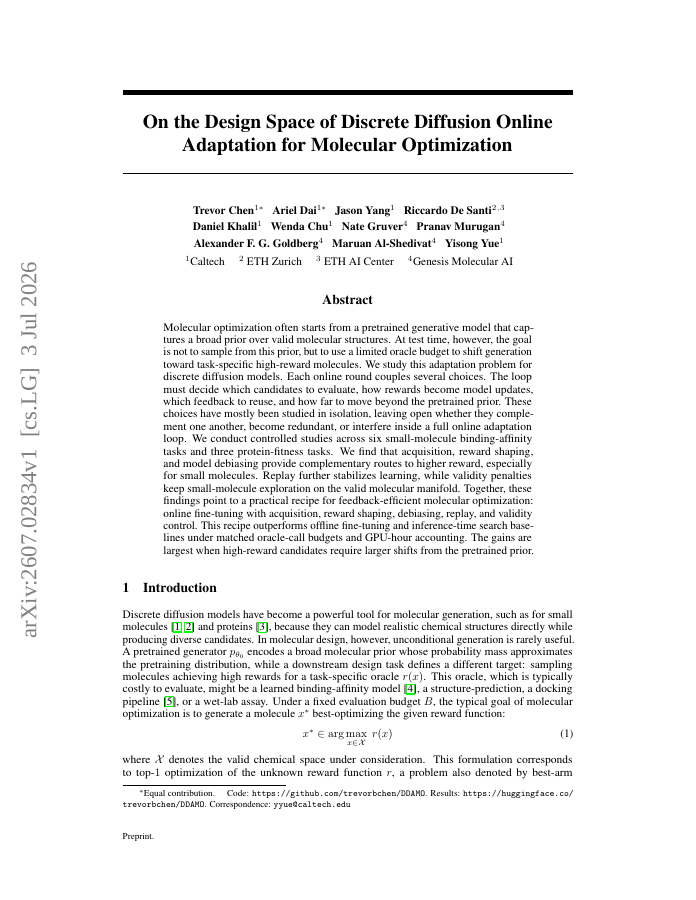
Molecular optimization often starts from a pretrained generative model that captures a broad prior over valid molecular structures. At test time, however, the goal is not to sample from this prior, but to use a limited oracle budget to shift generation toward task-specific high-reward molecules. We study this adaptation problem for discrete diffusion models. Each online round couples several choices. The loop must decide which candidates to evaluate, how rewards become model updates, which feedback to reuse, and how far to move beyond the pretrained prior. These choices have mostly been studied in isolation, leaving open whether they complement one another, become redundant, or interfere inside a full online adaptation loop. We conduct controlled studies across six small-molecule binding-affinity tasks and three protein-fitness tasks. We find that acquisition, reward shaping, and model debiasing provide complementary routes to higher reward, especially for small molecules. Replay further stabilizes learning, while validity penalties keep small-molecule exploration on the valid molecular manifold. Together, these findings point to a practical recipe for feedback-efficient molecular optimization: online fine-tuning with acquisition, reward shaping, debiasing, replay, and validity control. This recipe outperforms offline fine-tuning and inference-time search baselines under matched oracle-call budgets and GPU-hour accounting. The gains are largest when high-reward candidates require larger shifts from the pretrained prior.
On the Design Space of Discrete Diffusion Online Adaptation for Molecular Optimization
Molecular optimization often starts from a pretrained generative model that captures a broad prior over valid molecular structures. At test time, however, the goal is not to sample from this prior, but to use a limited oracle budget to shift generation toward task-specific…
- Preview
- Year
- 2026
- Hosting
- Full text hostedCC-BY-4.0
Cite
Notes
Only stored in your browser.
Attribution
- Abstract & full text
- arxiv.org/abs/2607.02834CC-BY-4.0
- TL;DR
- Semantic Scholar