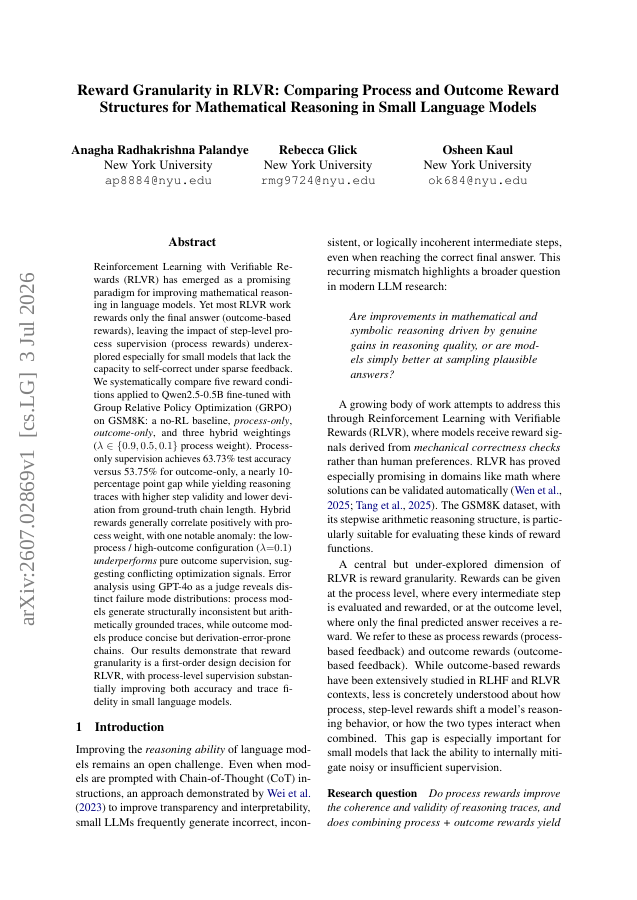
Reinforcement Learning with Verifiable Rewards (RLVR) has emerged as a promising paradigm for improving mathematical reasoning in language models. Yet most RLVR work rewards only the final answer (outcome-based rewards), leaving the impact of step-level process supervision (process rewards) underexplored especially for small models that lack the capacity to self-correct under sparse feedback. We systematically compare five reward conditions applied to Qwen2.5-0.5B fine-tuned with Group Relative Policy Optimization (GRPO) on GSM8K: a no-RL baseline, process-only, outcome-only, and three hybrid weightings (λ\in {0.9, 0.5, 0.1} process weight). Process-only supervision achieves 63.73% test accuracy versus 53.75% for outcome-only, a nearly 10-percentage point gap while yielding reasoning traces with higher step validity and lower deviation from ground-truth chain length. Hybrid rewards generally correlate positively with process weight, with one notable anomaly: the low-process / high-outcome configuration (λ=0.1) underperforms pure outcome supervision, suggesting conflicting optimization signals. Error analysis using GPT-4o as a judge reveals distinct failure mode distributions: process models generate structurally inconsistent but arithmetically grounded traces, while outcome models produce concise but derivation-error-prone chains. Our results demonstrate that reward granularity is a first-order design decision for RLVR, with process-level supervision substantially improving both accuracy and trace fidelity in small language models.
Reward Granularity in RLVR: Comparing Process and Outcome Reward Structures for Mathematical Reasoning in Small Language Models
Reinforcement Learning with Verifiable Rewards (RLVR) has emerged as a promising paradigm for improving mathematical reasoning in language models. Yet most RLVR work rewards only the final answer (outcome-based rewards), leaving the impact of step-level process supervision…
- Preview
- Year
- 2026
- Hosting
- Full text hostedCC-BY-4.0
Cite
Notes
Only stored in your browser.
Attribution
- Abstract & full text
- arxiv.org/abs/2607.02869CC-BY-4.0
- TL;DR
- Semantic Scholar