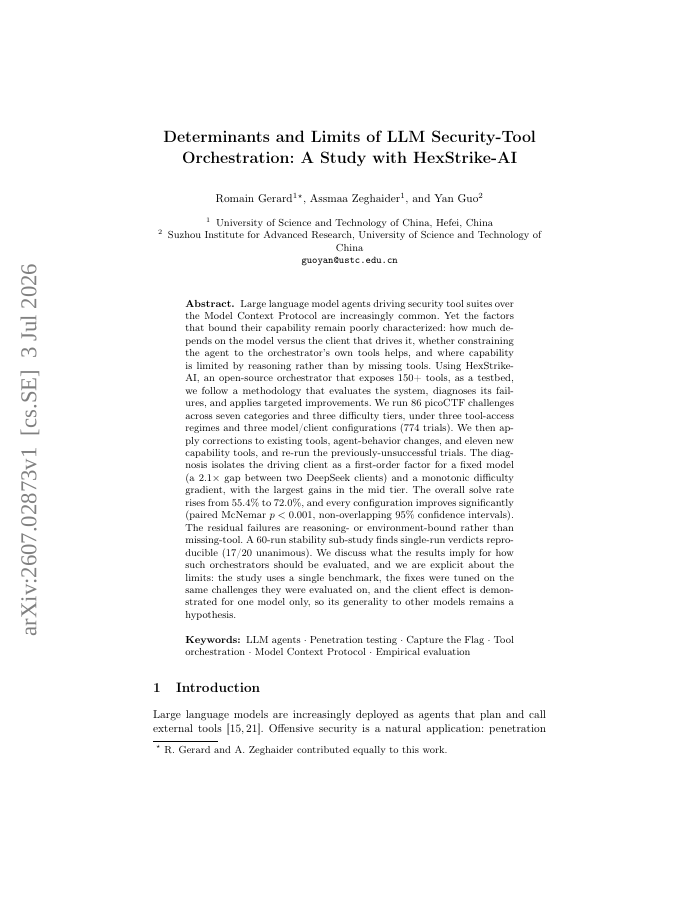
Large language model agents driving security tool suites over the Model Context Protocol are increasingly common. Yet the factors that bound their capability remain poorly characterized: how much depends on the model versus the client that drives it, whether constraining the agent to the orchestrator's own tools helps, and where capability is limited by reasoning rather than by missing tools. Using HexStrikeAI, an open-source orchestrator that exposes 150+ tools, as a testbed, we follow a methodology that evaluates the system, diagnoses its failures, and applies targeted improvements. We run 86 picoCTF challenges across seven categories and three difficulty tiers, under three tool-access regimes and three model/client configurations (774 trials). We then apply corrections to existing tools, agent-behavior changes, and eleven new capability tools, and re-run the previously-unsuccessful trials. The diagnosis isolates the driving client as a first-order factor for a fixed model (a 2.1 * gap between two DeepSeek clients) and a monotonic difficulty gradient, with the largest gains in the mid tier. The overall solve rate rises from 55.4% to 72.0%, and every configuration improves significantly (paired McNemar p < 0.001, non-overlapping 95% confidence intervals). The residual failures are reasoning- or environment-bound rather than missing-tool. A 60-run stability sub-study finds single-run verdicts reproducible (17/20 unanimous). We discuss what the results imply for how such orchestrators should be evaluated, and we are explicit about the limits: the study uses a single benchmark, the fixes were tuned on the same challenges they were evaluated on, and the client effect is demonstrated for one model only, so its generality to other models remains a hypothesis.
Determinants and Limits of LLM Security-Tool Orchestration: A Study with HexStrike-AI
Large language model agents driving security tool suites over the Model Context Protocol are increasingly common. Yet the factors that bound their capability remain poorly characterized: how much depends on the model versus the client that drives it, whether constraining the…
- Preview
- Year
- 2026
- Hosting
- Excerpt onlyCC-BY-NC-4.0
Cite
Notes
Only stored in your browser.
Attribution
- Abstract & full text
- arxiv.org/abs/2607.02873CC-BY-NC-4.0
- TL;DR
- Semantic Scholar