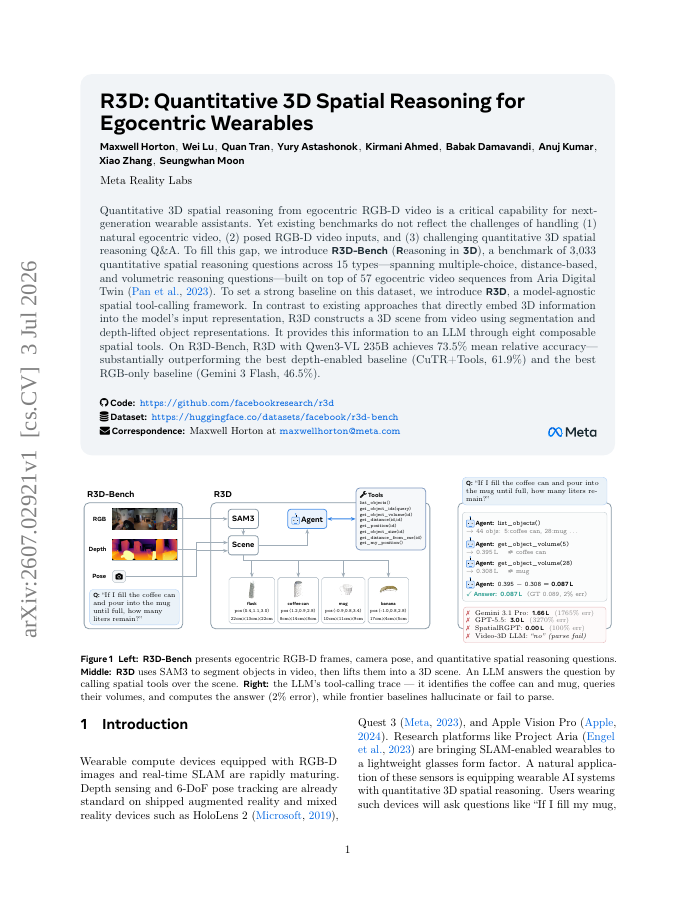
Quantitative 3D spatial reasoning from egocentric RGB-D video is a critical capability for next-generation wearable assistants. Yet existing benchmarks do not reflect the challenges of handling (1) natural egocentric video, (2) posed RGB-D video inputs, and (3) challenging quantitative 3D spatial reasoning Q&A. To fill this gap, we introduce R3D-Bench (Reasoning in 3D), a benchmark of 3,033 quantitative spatial reasoning questions across 15 types -- spanning multiple-choice, distance-based, and volumetric reasoning questions -- built on top of 57 egocentric video sequences from Aria Digital Twin. To set a strong baseline on this dataset, we introduce R3D, a model-agnostic spatial tool-calling framework. In contrast to existing approaches that directly embed 3D information into the model's input representation, R3D constructs a 3D scene from video using segmentation and depth-lifted object representations. It provides this information to an LLM through eight composable spatial tools. On R3D-Bench, R3D with Qwen3-VL 235B achieves 73.5% mean relative accuracy, substantially outperforming the best depth-enabled baseline (CuTR+Tools, 61.9%) and the best RGB-only baseline (Gemini 3 Flash, 46.5%).
R3D: Quantitative 3D Spatial Reasoning for Egocentric Wearables
Quantitative 3D spatial reasoning from egocentric RGB-D video is a critical capability for next-generation wearable assistants. Yet existing benchmarks do not reflect the challenges of handling (1) natural egocentric video, (2) posed RGB-D video inputs, and (3) challenging…
- Preview
- Year
- 2026
- Hosting
- Abstract onlyARXIV-DEFAULT
Cite
Notes
Only stored in your browser.
Attribution
- Abstract & full text
- arxiv.org/abs/2607.02921ARXIV-DEFAULT
- TL;DR
- Semantic Scholar