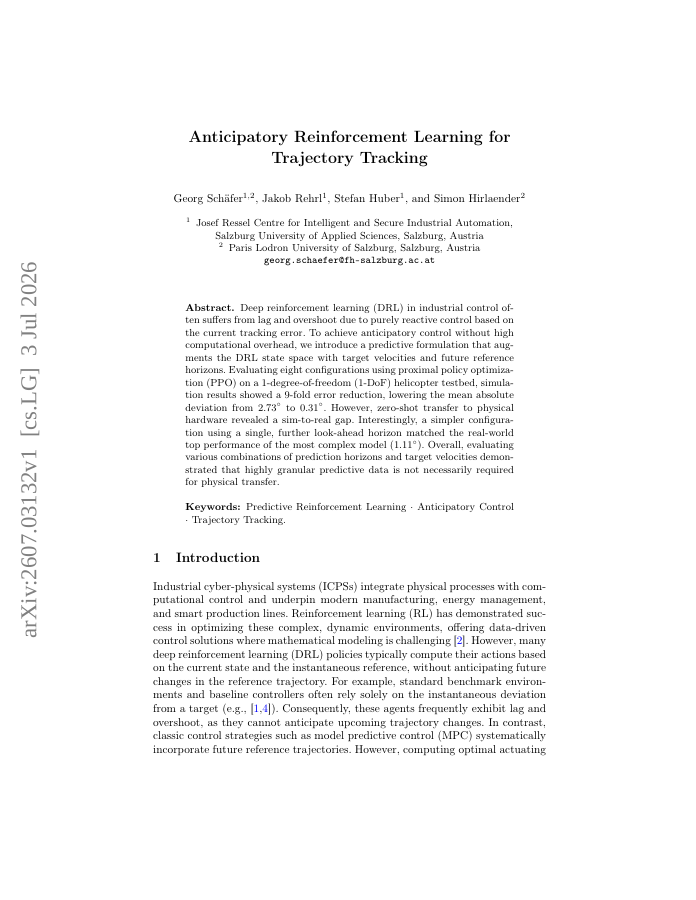
Deep reinforcement learning (DRL) in industrial control often suffers from lag and overshoot due to purely reactive control based on the current tracking error. To achieve anticipatory control without high computational overhead, we introduce a predictive formulation that augments the DRL state space with target velocities and future reference horizons. Evaluating eight configurations using proximal policy optimization (PPO) on a 1-degree-of-freedom (1-DoF) helicopter testbed, simulation results showed a 9-fold error reduction, lowering the mean absolute deviation from 2.73° to 0.31°. However, zero-shot transfer to physical hardware revealed a sim-to-real gap. Interestingly, a simpler configuration using a single, further look-ahead horizon matched the real-world top performance of the most complex model (1.11°). Overall, evaluating various combinations of prediction horizons and target velocities demonstrated that highly granular predictive data is not necessarily required for physical transfer.
Anticipatory Reinforcement Learning for Trajectory Tracking
Deep reinforcement learning (DRL) in industrial control often suffers from lag and overshoot due to purely reactive control based on the current tracking error. To achieve anticipatory control without high computational overhead, we introduce a predictive formulation that…
- Preview
- Year
- 2026
- Hosting
- Excerpt onlyCC-BY-NC-4.0
Cite
Notes
Only stored in your browser.
Attribution
- Abstract & full text
- arxiv.org/abs/2607.03132CC-BY-NC-4.0
- TL;DR
- Semantic Scholar