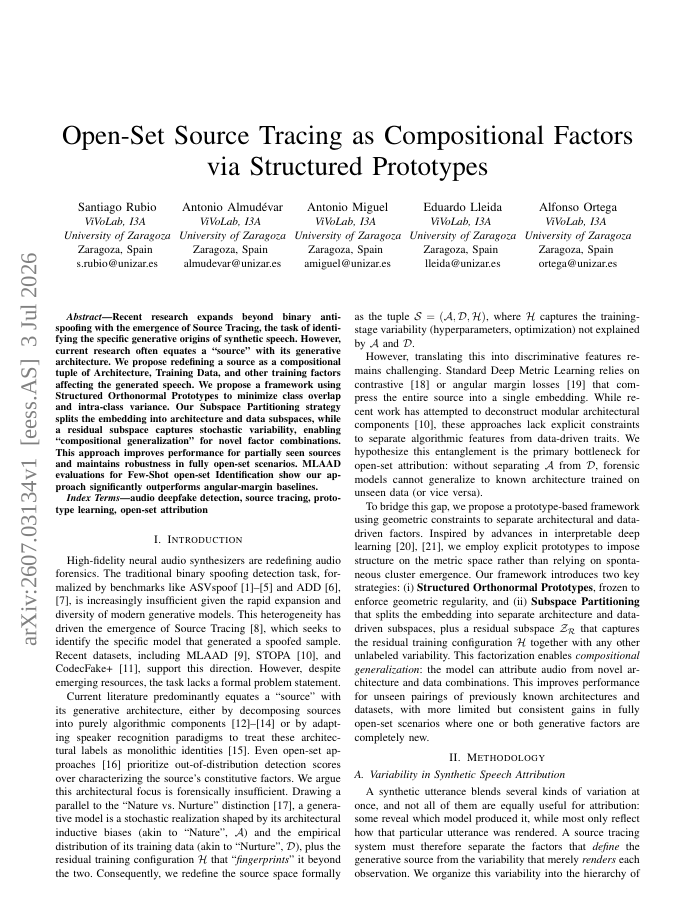
Recent research expands beyond binary anti-spoofing with the emergence of Source Tracing, the task of identifying the specific generative origins of synthetic speech. However, current research often equates a "source" with its generative architecture. We propose redefining a source as a compositional tuple of Architecture, Training Data, and other training factors affecting the generated speech. We propose a framework using Structured Orthonormal Prototypes to minimize class overlap and intra-class variance. Our Subspace Partitioning strategy splits the embedding into architecture and data subspaces, while a residual subspace captures stochastic variability, enabling "compositional generalization" for novel factor combinations. This approach improves performance for partially seen sources and maintains robustness in fully open-set scenarios. MLAAD evaluations for Few-Shot open-set Identification show our approach significantly outperforms angular-margin baselines.
Open-Set Source Tracing as Compositional Factors via Structured Prototypes
Recent research expands beyond binary anti-spoofing with the emergence of Source Tracing, the task of identifying the specific generative origins of synthetic speech. However, current research often equates a "source" with its generative architecture.
- Preview
- Year
- 2026
- Hosting
- Full text hostedCC-BY-4.0
Cite
Notes
Only stored in your browser.
Attribution
- Abstract & full text
- arxiv.org/abs/2607.03134CC-BY-4.0
- TL;DR
- Semantic Scholar