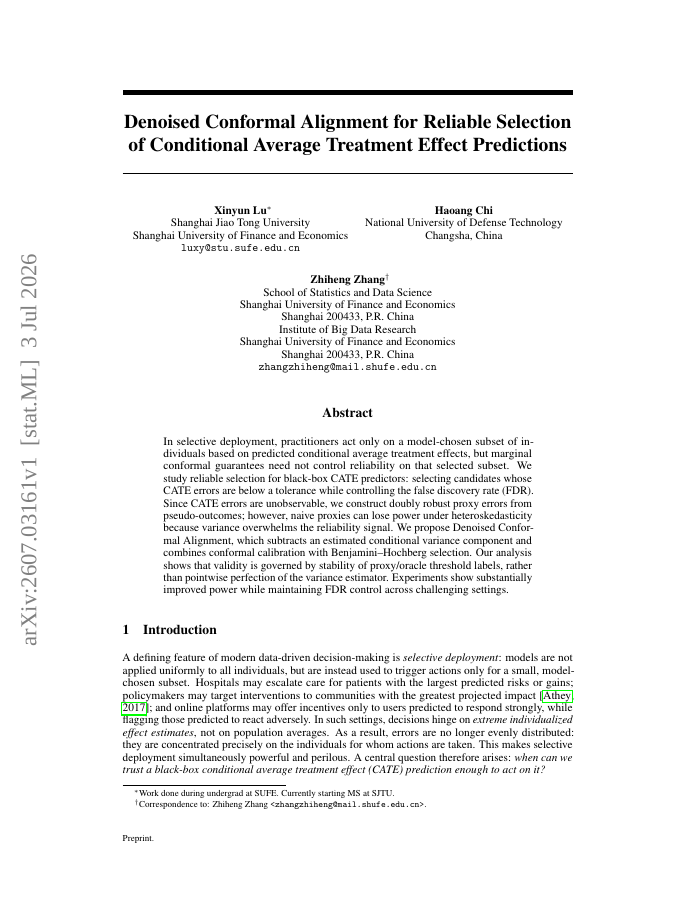
In selective deployment, practitioners act only on a model-chosen subset of individuals based on predicted conditional average treatment effects, but marginal conformal guarantees need not control reliability on that selected subset. We study reliable selection for black-box CATE predictors: selecting candidates whose CATE errors are below a tolerance while controlling the false discovery rate (FDR). Since CATE errors are unobservable, we construct doubly robust proxy errors from pseudo-outcomes; however, naive proxies can lose power under heteroskedasticity because variance overwhelms the reliability signal. We propose Denoised Conformal Alignment, which subtracts an estimated conditional variance component and combines conformal calibration with Benjamini--Hochberg selection. Our analysis shows that validity is governed by stability of proxy/oracle threshold labels, rather than pointwise perfection of the variance estimator. Experiments show substantially improved power while maintaining FDR control across challenging settings.
Denoised Conformal Alignment for Reliable Selection of Conditional Average Treatment Effect Predictions
In selective deployment, practitioners act only on a model-chosen subset of individuals based on predicted conditional average treatment effects, but marginal conformal guarantees need not control reliability on that selected subset.
- Preview
- Year
- 2026
- Hosting
- Abstract onlyARXIV-DEFAULT
Cite
Notes
Only stored in your browser.
Attribution
- Abstract & full text
- arxiv.org/abs/2607.03161ARXIV-DEFAULT
- TL;DR
- Semantic Scholar