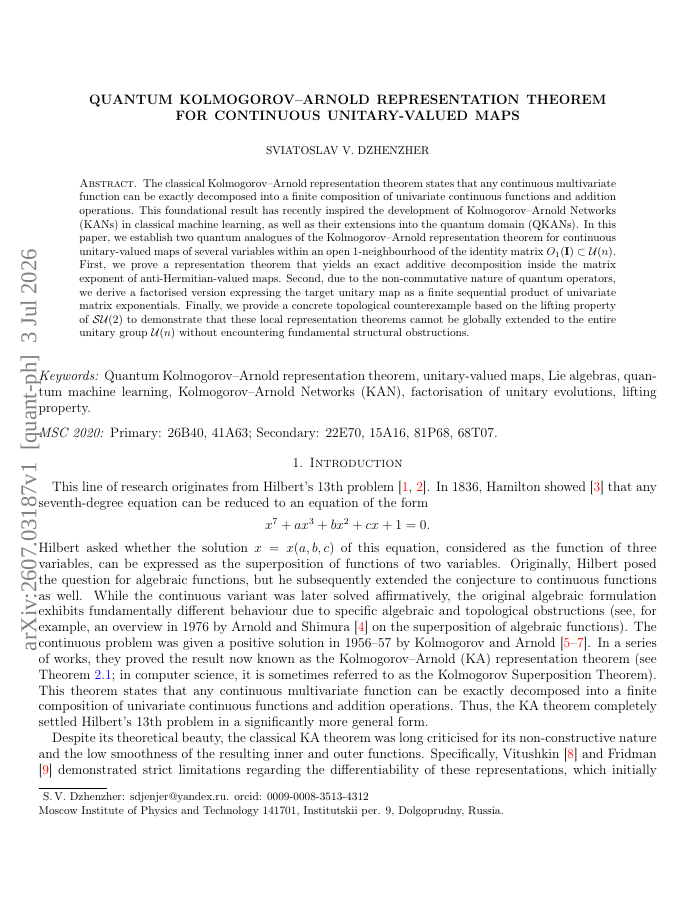
The classical Kolmogorov--Arnold representation theorem states that any continuous multivariate function can be exactly decomposed into a finite composition of univariate continuous functions and addition operations. This foundational result has recently inspired the development of Kolmogorov--Arnold Networks (KANs) in classical machine learning, as well as their extensions into the quantum domain (QKANs). In this paper, we establish two quantum analogues of the Kolmogorov--Arnold representation theorem for continuous unitary-valued maps of several variables within an open 1-neighbourhood of the identity matrix O_1(I) \subset U(n). First, we prove a representation theorem that yields an exact additive decomposition inside the matrix exponent of anti-Hermitian-valued maps. Second, due to the non-commutative nature of quantum operators, we derive a factorised version expressing the target unitary map as a finite sequential product of univariate matrix exponentials. Finally, we provide a concrete topological counterexample based on the lifting property of SU(2) to demonstrate that these local representation theorems cannot be globally extended to the entire unitary group U(n) without encountering fundamental structural obstructions.
Quantum Kolmogorov--Arnold representation theorem for continuous unitary-valued maps
The classical Kolmogorov--Arnold representation theorem states that any continuous multivariate function can be exactly decomposed into a finite composition of univariate continuous functions and addition operations.
- Preview
- Year
- 2026
- Hosting
- Excerpt onlyCC-BY-NC-SA-4.0
Cite
Notes
Only stored in your browser.
Attribution
- Abstract & full text
- arxiv.org/abs/2607.03187CC-BY-NC-SA-4.0
- TL;DR
- Semantic Scholar