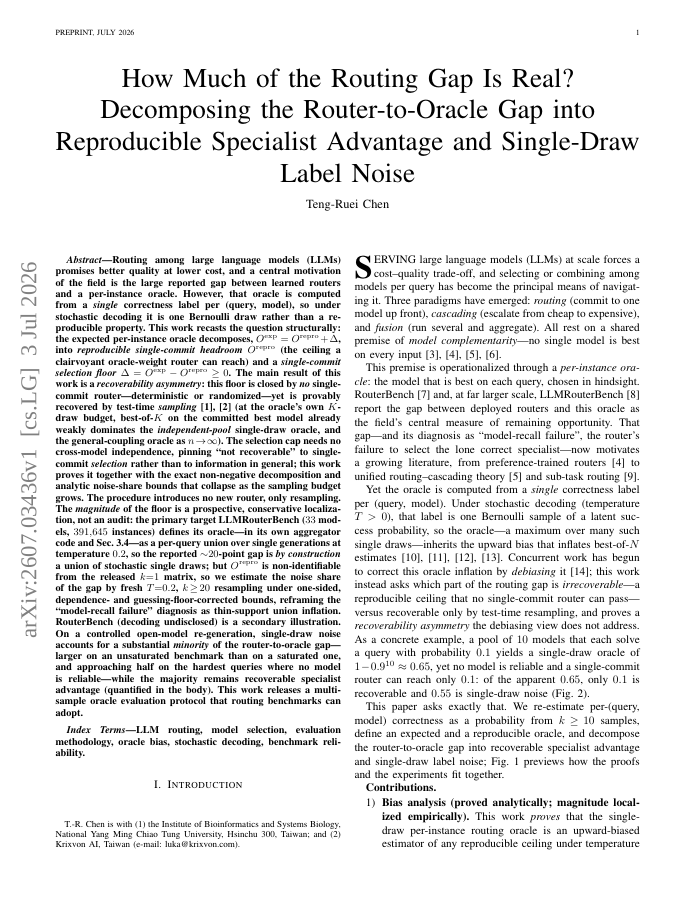
Routing among large language models (LLMs) promises better quality at lower cost, motivated by the reported gap between learned routers and a per-instance oracle. But that oracle is computed from a single correctness label per (query, model), so under stochastic decoding it is one Bernoulli draw, not a reproducible property. We recast the question structurally: the expected per-instance oracle decomposes as O^{\exp}=O^{repro}+Δ, into reproducible single-commit headroom O^{repro} and a non-negative single-commit selection floor Δ. Our main result is a recoverability asymmetry: this floor is closed by no single-commit router, yet is recovered by test-time sampling -- best-of-K on the committed model, at the oracle's own budget, dominates the independent-pool single-draw oracle. The cap needs no cross-model independence; we prove it with the exact decomposition and noise-share bounds that shrink as the budget grows. The procedure adds no new router, only resampling. The floor's magnitude is a prospective, conservative localization, not an audit: our primary target LLMRouterBench (33 models, 391,645 instances) defines its oracle as a per-query union over single T=0.2 generations -- by construction a union of stochastic single draws. Since O^{repro} is non-identifiable from the released k=1 matrix, we estimate the noise share by fresh k\ge20 resampling under one-sided, dependence- and guessing-floor-corrected bounds, recasting 'model-recall failure' as thin-support union inflation. On a controlled open-model re-generation, single-draw noise is a substantial minority of the gap -- larger on an unsaturated benchmark, approaching half on the hardest queries where no model is reliable -- while the majority remains recoverable specialist advantage. We release a multi-sample oracle evaluation protocol for routing benchmarks.
How Much of the Routing Gap Is Real? Decomposing the Router-to-Oracle Gap into Reproducible Specialist Advantage and Single-Draw Label Noise
Routing among large language models (LLMs) promises better quality at lower cost, motivated by the reported gap between learned routers and a per-instance oracle. But that oracle is computed from a single correctness label per (query, model), so under stochastic decoding it is…
- Preview
- Year
- 2026
- Hosting
- Abstract onlyARXIV-DEFAULT
Cite
Notes
Only stored in your browser.
Attribution
- Abstract & full text
- arxiv.org/abs/2607.03436ARXIV-DEFAULT
- TL;DR
- Semantic Scholar