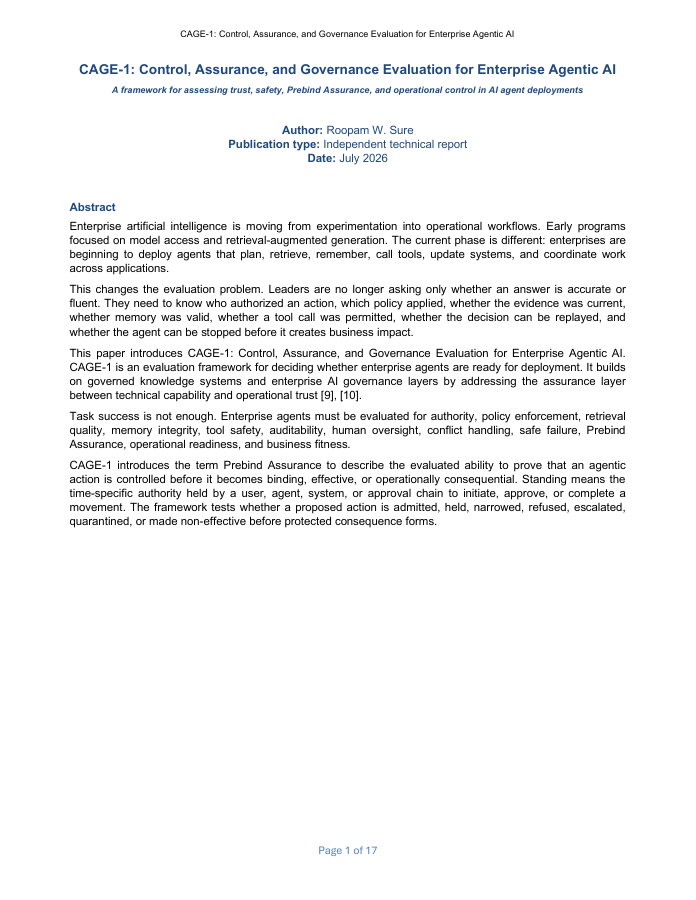
Enterprise artificial intelligence is moving from experimentation into operational workflows. Early programs focused on model access and retrieval-augmented generation, but enterprises are now beginning to deploy agents that plan, retrieve, remember, call tools, update systems, and coordinate work across applications. This changes the evaluation problem. Leaders are no longer asking only whether an answer is accurate or fluent. They need to know who authorized an action, which policy applied, whether evidence was current, whether memory was valid, whether a tool call was permitted, whether the decision can be replayed, and whether the agent can be stopped before it creates business impact. This paper introduces CAGE-1: Control, Assurance, and Governance Evaluation for Enterprise Agentic AI. CAGE-1 is an evaluation framework for deciding whether enterprise agents are ready for deployment. It evaluates authority, policy enforcement, retrieval quality, memory integrity, tool safety, auditability, human oversight, conflict handling, safe failure, Prebind Assurance, operational readiness, and business fitness. CAGE-1 introduces Prebind Assurance to describe the evaluated ability to prove that an agentic action is controlled before it becomes binding, effective, or operationally consequential. The framework tests whether a proposed action is admitted, held, narrowed, refused, escalated, quarantined, or made non-effective before protected consequence forms.
CAGE-1: Control, Assurance, and Governance Evaluation for Enterprise Agentic AI
Enterprise artificial intelligence is moving from experimentation into operational workflows. Early programs focused on model access and retrieval-augmented generation, but enterprises are now beginning to deploy agents that plan, retrieve, remember, call tools, update systems,…
- Preview
- Year
- 2026
- Hosting
- Abstract onlyARXIV-DEFAULT
Cite
Notes
Only stored in your browser.
Attribution
- Abstract & full text
- arxiv.org/abs/2607.03510ARXIV-DEFAULT
- TL;DR
- Semantic Scholar