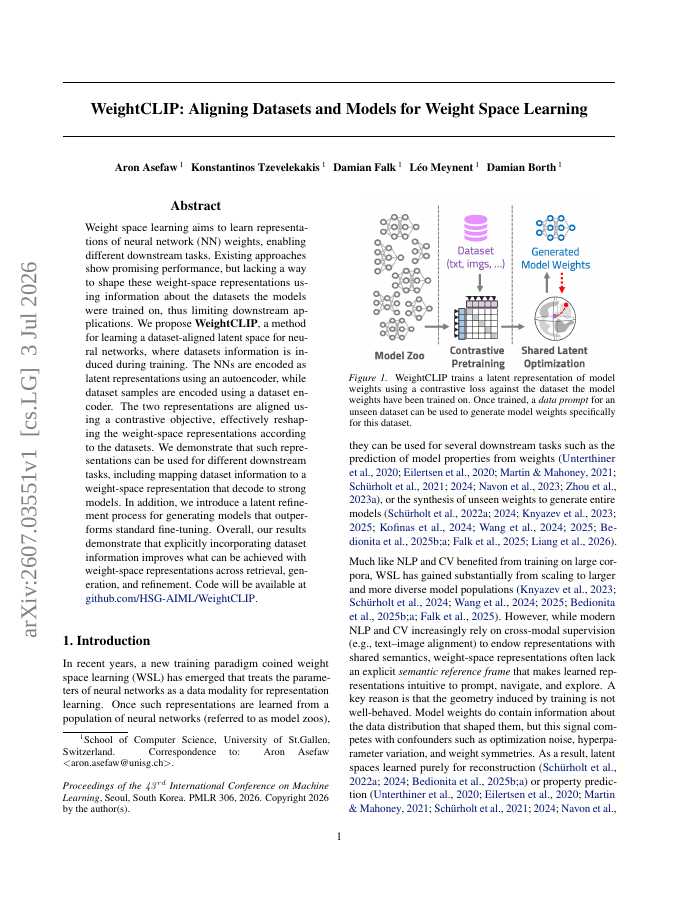
Weight space learning aims to learn representations of neural network (NN) weights, enabling different downstream tasks. Existing approaches show promising performance, but lacking a way to shape these weight-space representations using information about the datasets the models were trained on, thus limiting downstream applications. We propose WeightCLIP, a method for learning a dataset-aligned latent space for neural networks, where datasets information is induced during training. The NNs are encoded as latent representations using an autoencoder, while dataset samples are encoded using a dataset encoder. The two representations are aligned using a contrastive objective, effectively reshaping the weight-space representations according to the datasets. We demonstrate that such representations can be used for different downstream tasks, including mapping dataset information to a weight-space representation that decode to strong models. In addition, we introduce a latent refinement process for generating models that outperforms standard fine-tuning. Overall, our results demonstrate that explicitly incorporating dataset information improves what can be achieved with weight-space representations across retrieval, generation, and refinement. Code will be available at https://github.com/HSG-AIML/WeightCLIP.
WeightCLIP: Aligning Datasets and Models for Weight Space Learning
Weight space learning aims to learn representations of neural network (NN) weights, enabling different downstream tasks. Existing approaches show promising performance, but lacking a way to shape these weight-space representations using information about the datasets the models…
- Preview
- Year
- 2026
- Hosting
- Full text hostedCC-BY-4.0
Cite
Notes
Only stored in your browser.
Attribution
- Abstract & full text
- arxiv.org/abs/2607.03551CC-BY-4.0
- TL;DR
- Semantic Scholar