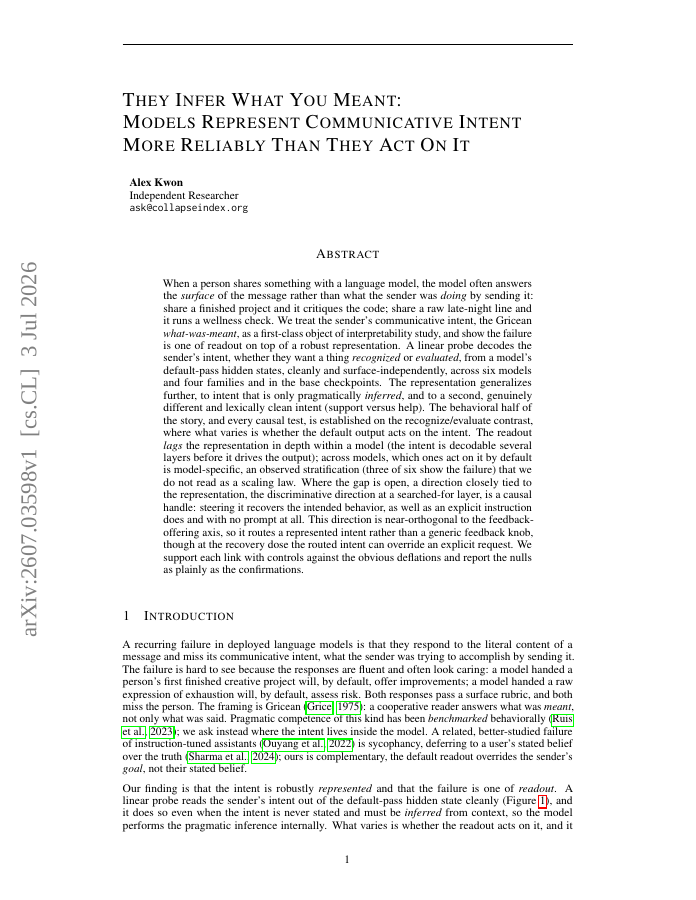
When a person shares something with a language model, the model often answers the surface of the message rather than what the sender was doing by sending it: share a finished project and it critiques the code; share a raw late-night line and it runs a wellness check. We treat the sender's communicative intent, the Gricean what-was-meant, as a first-class interpretability object, and show the failure is one of readout on top of a robust representation. A linear probe decodes the sender's intent, whether they want a thing recognized or evaluated, from a model's default-pass hidden states, cleanly and surface-independently, across six models and four families and in the base checkpoints. The representation generalizes further, to intent that is only pragmatically inferred, and to a second, lexically clean intent (support versus help). The behavioral half of the story, and every causal test, is established on the recognize/evaluate contrast, where what varies is whether the default output acts on the intent. The readout lags the representation in depth within a model (the intent is decodable several layers before it drives the output); across models, which ones act on it by default is model-specific, an observed stratification (three of six show the failure) that we do not read as a scaling law. Where the gap is open, a direction closely tied to the representation, the discriminative direction at a searched-for layer, is a causal handle: steering it recovers the intended behavior, as well as an explicit instruction does and with no prompt at all. This direction is near-orthogonal to the feedback-offering axis, so it routes a represented intent rather than a generic feedback knob, though at the recovery dose the routed intent can override an explicit request. We support each link with controls against obvious deflations and report the nulls as plainly as the confirmations.
They Infer What You Meant: Models Represent Communicative Intent More Reliably Than They Act On It
When a person shares something with a language model, the model often answers the surface of the message rather than what the sender was doing by sending it: share a finished project and it critiques the code; share a raw late-night line and it runs a wellness check.
- Preview
- Year
- 2026
- Hosting
- Full text hostedCC-BY-4.0
Cite
Notes
Only stored in your browser.
Attribution
- Abstract & full text
- arxiv.org/abs/2607.03598CC-BY-4.0
- TL;DR
- Semantic Scholar