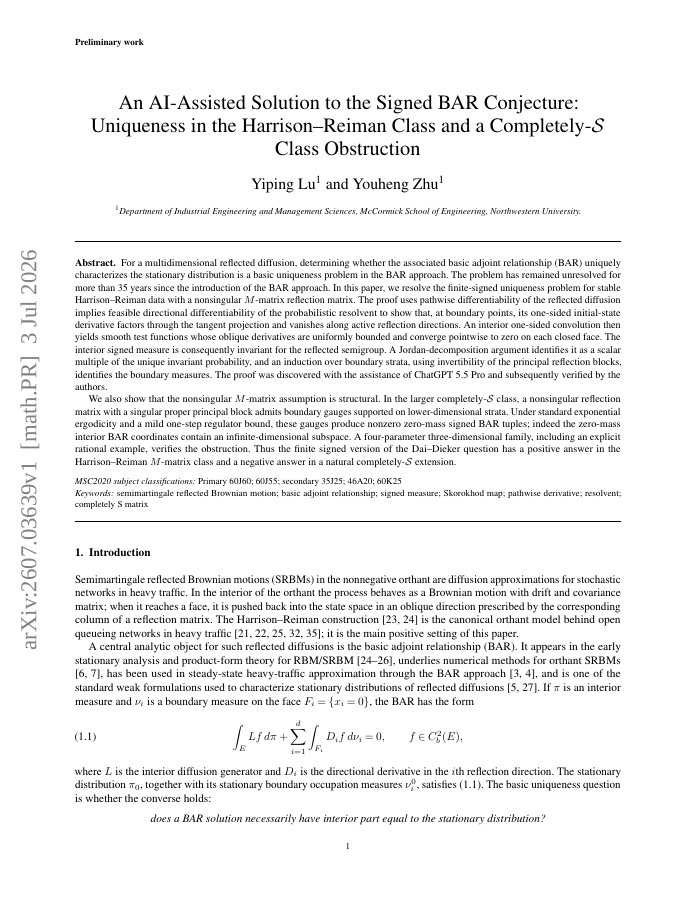
For a multidimensional reflected diffusion, determining whether the associated basic adjoint relationship (BAR) uniquely characterizes the stationary distribution is a basic uniqueness problem in the BAR approach. The problem has remained unresolved for more than 35 years since the introduction of the BAR approach. In this paper, we resolve the finite-signed uniqueness problem for stable Harrison--Reiman data with a nonsingular M-matrix reflection matrix. The proof uses pathwise differentiability of the reflected diffusion implies feasible directional differentiability of the probabilistic resolvent to show that, at boundary points, its one-sided initial-state derivative factors through the tangent projection and vanishes along active reflection directions. An interior one-sided convolution then yields smooth test functions whose oblique derivatives are uniformly bounded and converge pointwise to zero on each closed face. The interior signed measure is consequently invariant for the reflected semigroup. The proof was discovered with the assistance of ChatGPT 5.5 Pro and subsequently verified by the authors. We also show that the nonsingular M-matrix assumption is structural. In the larger completely-S class, a nonsingular reflection matrix with a singular proper principal block admits boundary gauges supported on lower-dimensional strata. Under standard exponential ergodicity and a mild one-step regulator bound, these gauges produce nonzero zero-mass signed BAR tuples; indeed the zero-mass interior BAR coordinates contain an infinite-dimensional subspace. A four-parameter three-dimensional family, including an explicit rational example, verifies the obstruction. Thus the finite signed version of the Dai--Dieker question has a positive answer in the Harrison--Reiman M-matrix class and a negative answer in a natural completely-S extension.
An AI-Assisted Solution to the Signed BAR Conjecture: Uniqueness in the Harrison--Reiman Class and a Completely-$\mathcal{S}$ Class Obstruction
For a multidimensional reflected diffusion, determining whether the associated basic adjoint relationship (BAR) uniquely characterizes the stationary distribution is a basic uniqueness problem in the BAR approach.
- Preview
- Year
- 2026
- Hosting
- Full text hostedCC-BY-4.0
Cite
Notes
Only stored in your browser.
Attribution
- Abstract & full text
- arxiv.org/abs/2607.03639CC-BY-4.0
- TL;DR
- Semantic Scholar