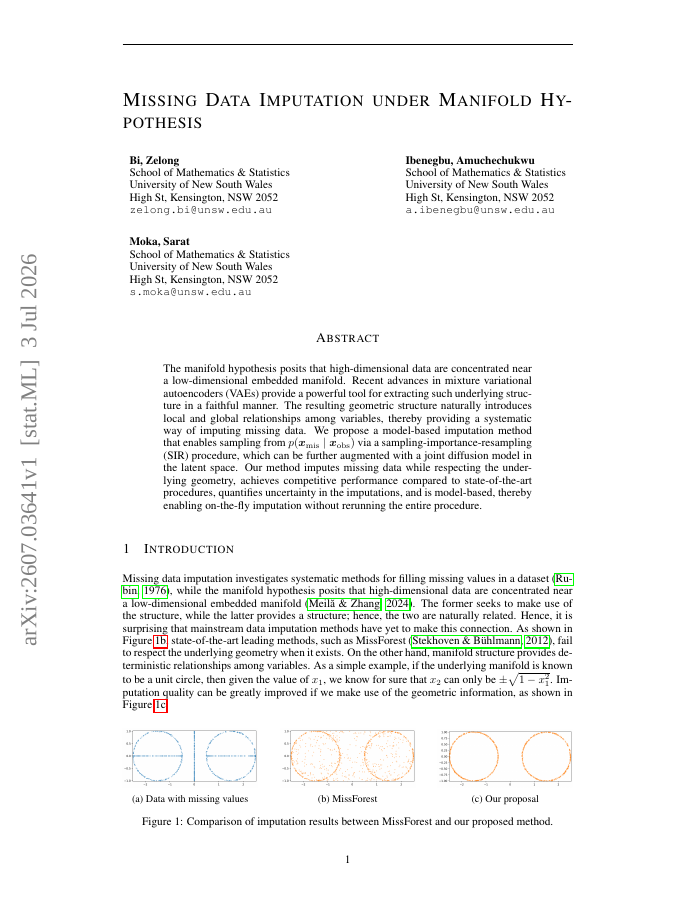
The manifold hypothesis posits that high-dimensional data are concentrated near a low-dimensional embedded manifold. Recent advances in mixture variational autoencoders (VAEs) provide a powerful tool for extracting such underlying structure in a faithful manner. The resulting geometric structure naturally introduces local and global relationships among variables, thereby providing a systematic way of imputing missing data. We propose a model-based imputation method that enables sampling from p(\bm{x}{mis} \mid \bm{x}{obs}) via a sampling-importance-resampling (SIR) procedure, which can be further augmented with a joint diffusion model in the latent space. Our method imputes missing data while respecting the underlying geometry, achieves competitive performance compared to state-of-the-art procedures, quantifies uncertainty in the imputations, and is model-based, thereby enabling on-the-fly imputation without rerunning the entire procedure.
Missing Data Imputation under Manifold Hypothesis
The manifold hypothesis posits that high-dimensional data are concentrated near a low-dimensional embedded manifold. Recent advances in mixture variational autoencoders (VAEs) provide a powerful tool for extracting such underlying structure in a faithful manner.
- Preview
- Year
- 2026
- Hosting
- Full text hostedCC-BY-4.0
Cite
Notes
Only stored in your browser.
Attribution
- Abstract & full text
- arxiv.org/abs/2607.03641CC-BY-4.0
- TL;DR
- Semantic Scholar