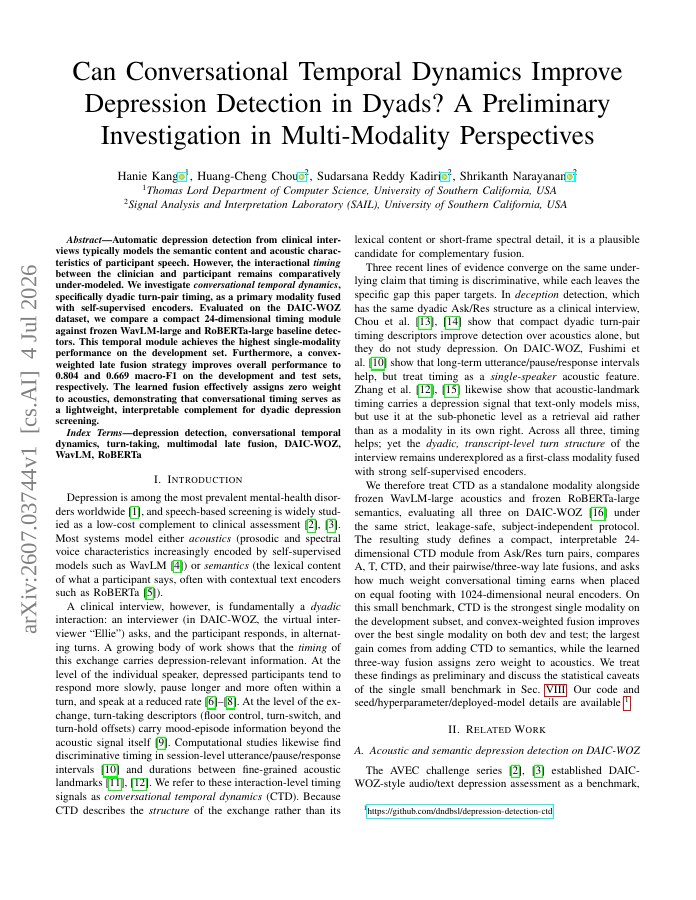
Automatic depression detection from clinical interviews typically models the semantic content and acoustic characteristics of participant speech. However, the interactional timing between the clinician and participant remains comparatively under-modeled. We investigate conversational temporal dynamics, specifically dyadic turn-pair timing, as a primary modality fused with self-supervised encoders. Evaluated on the DAIC-WOZ dataset, we compare a compact 24-dimensional timing module against frozen WavLM-large and RoBERTa-large baseline detectors. This temporal module achieves the highest single-modality performance on the development set. Furthermore, a convex-weighted late fusion strategy improves overall performance to 0.804 and 0.669 macro-F1 on the development and test sets, respectively. The learned fusion effectively assigns zero weight to acoustics, demonstrating that conversational timing serves as a lightweight, interpretable complement for dyadic depression screening.
Can Conversational Temporal Dynamics Improve Depression Detection in Dyads? A Preliminary Investigation in Multi-Modality Perspectives
Automatic depression detection from clinical interviews typically models the semantic content and acoustic characteristics of participant speech. However, the interactional timing between the clinician and participant remains comparatively under-modeled.
- Preview
- Year
- 2026
- Hosting
- Full text hostedCC-BY-4.0
Cite
Notes
Only stored in your browser.
Attribution
- Abstract & full text
- arxiv.org/abs/2607.03744CC-BY-4.0
- TL;DR
- Semantic Scholar