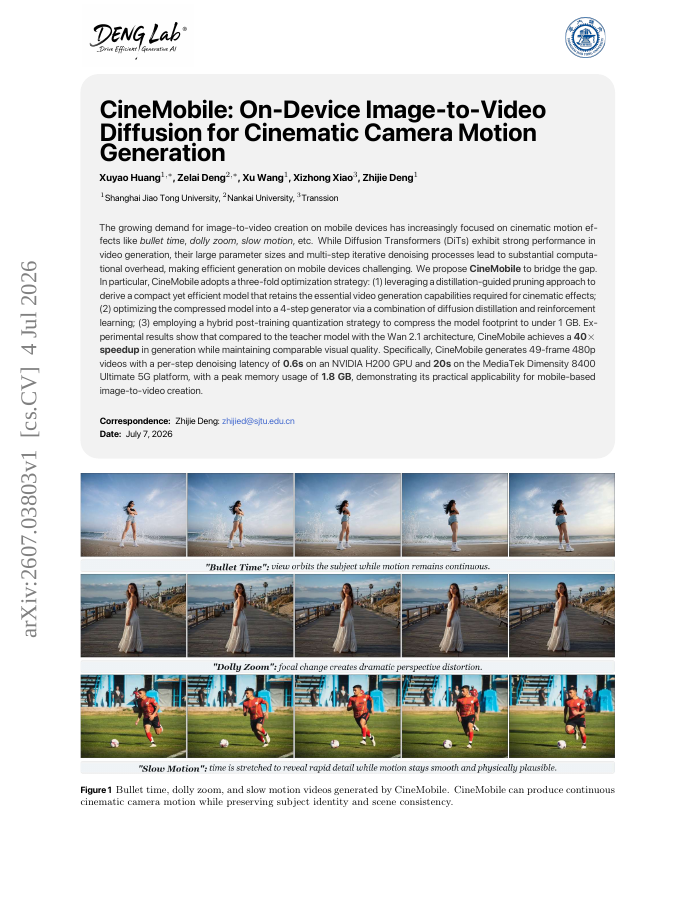
The growing demand for image-to-video creation on mobile devices has increasingly focused on cinematic motion effects like bullet time, dolly zoom, slow motion, etc. While Diffusion Transformers (DiTs) exhibit strong performance in video generation, their large parameter sizes and multi-step iterative denoising processes lead to substantial computational overhead, making efficient generation on mobile devices challenging. We propose CineMobile to bridge the gap. In particular, CineMobile adopts a three-fold optimization strategy: (1) leveraging a distillation-guided pruning approach to derive a compact yet efficient model that retains the essential video generation capabilities required for cinematic effects; (2) optimizing the compressed model into a 4-step generator via a combination of diffusion distillation and reinforcement learning; (3) employing a hybrid post-training quantization strategy to compress the model footprint to under 1 GB. Experimental results show that compared to the teacher model with the Wan 2.1 architecture, CineMobile achieves a 40x speedup in generation while maintaining comparable visual quality. Specifically, CineMobile generates 49-frame 480p videos with a per-step denoising latency of 0.6s on an NVIDIA H200 GPU and 20s on the MediaTek Dimensity 8400 Ultimate 5G platform, with a peak memory usage of 1.8 GB, demonstrating its practical applicability for mobile-based image-to-video creation.
CineMobile: On-Device Image-to-Video Diffusion for Cinematic Camera Motion Generation
The growing demand for image-to-video creation on mobile devices has increasingly focused on cinematic motion effects like bullet time, dolly zoom, slow motion, etc. While Diffusion Transformers (DiTs) exhibit strong performance in video generation, their large parameter sizes…
- Preview
- Year
- 2026
- Hosting
- Full text hostedCC-BY-4.0
Cite
Notes
Only stored in your browser.
Attribution
- Abstract & full text
- arxiv.org/abs/2607.03803CC-BY-4.0
- TL;DR
- Semantic Scholar