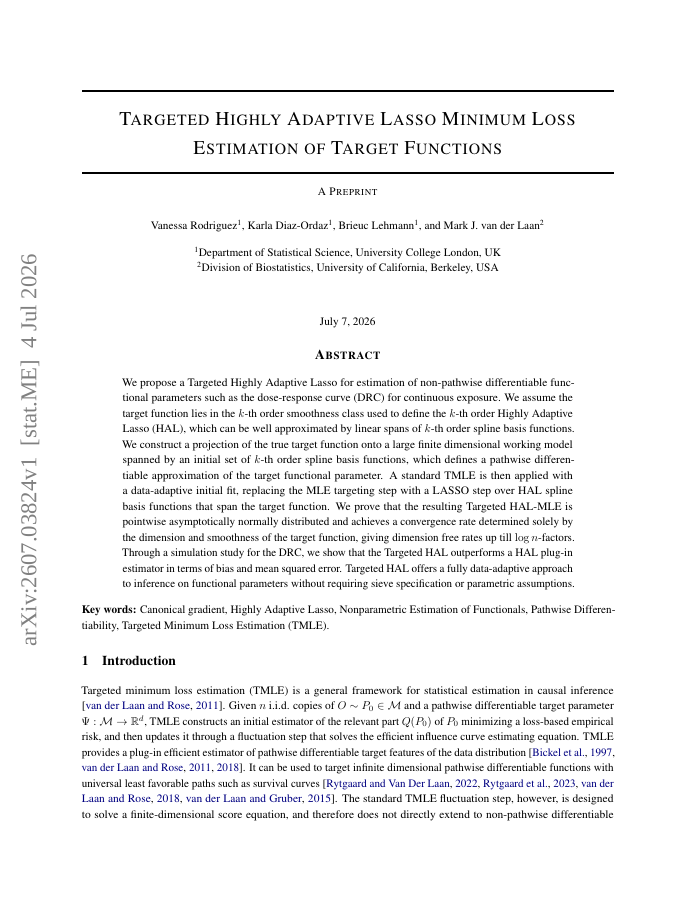
We propose a Targeted Highly Adaptive Lasso for estimation of non-pathwise differentiable functional parameters such as the dose-response curve (DRC) for continuous exposure. We assume the target function lies in the k-th order smoothness class used to define the k-th order Highly Adaptive Lasso (HAL), which can be well approximated by linear spans of k-th order spline basis functions. We construct a projection of the true target function onto a large finite dimensional working model spanned by an initial set of k-th order spline basis functions, which defines a pathwise differentiable approximation of the target functional parameter. A standard TMLE is then applied with a data-adaptive initial fit, replacing the MLE targeting step with a LASSO step over HAL spline basis functions that span the target function. We prove that the resulting Targeted HAL-MLE is pointwise asymptotically normally distributed and achieves a convergence rate determined solely by the dimension and smoothness of the target function, giving dimension free rates up till \log n-factors. Through a simulation study for the DRC, we show that the Targeted HAL outperforms a HAL plug-in estimator in terms of bias and mean squared error. Targeted HAL offers a fully data-adaptive approach to inference on functional parameters without requiring sieve specification or parametric assumptions.
Targeted Highly Adaptive Lasso Minimum Loss Estimation of Target Functions
We propose a Targeted Highly Adaptive Lasso for estimation of non-pathwise differentiable functional parameters such as the dose-response curve (DRC) for continuous exposure.
- Preview
- Year
- 2026
- Hosting
- Full text hostedCC-BY-4.0
Cite
Notes
Only stored in your browser.
Attribution
- Abstract & full text
- arxiv.org/abs/2607.03824CC-BY-4.0
- TL;DR
- Semantic Scholar