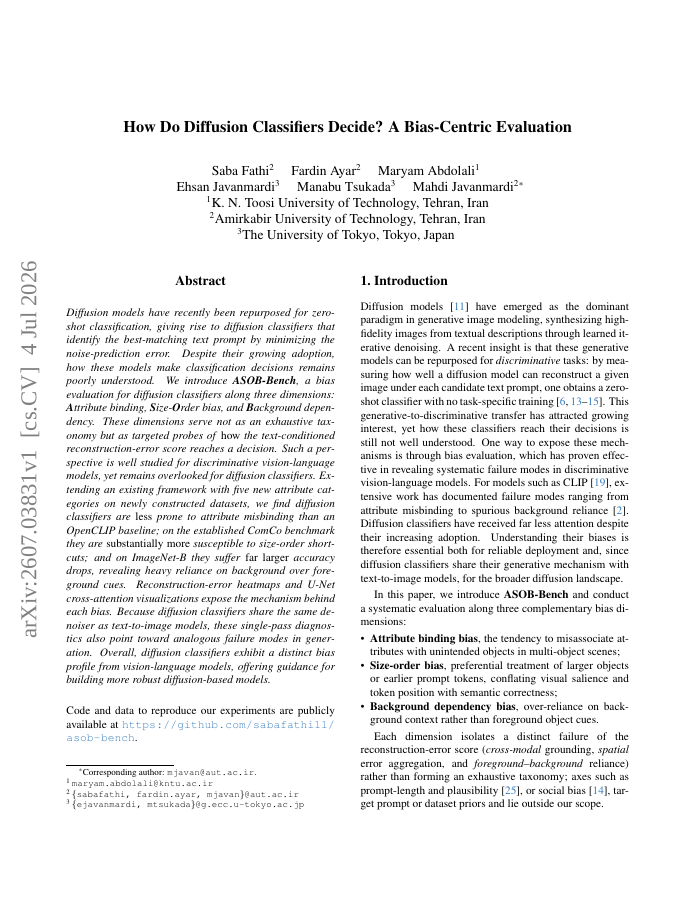
Diffusion models have recently been repurposed for zero-shot classification, giving rise to diffusion classifiers that identify the best-matching text prompt by minimizing the noise-prediction error. Despite their growing adoption, how these models make classification decisions remains poorly understood. We introduce ASOB-Bench, a bias evaluation for diffusion classifiers along three dimensions: Attribute binding, Size-Order bias, and Background dependency. These dimensions serve not as an exhaustive taxonomy but as targeted probes of how the text-conditioned reconstruction-error score reaches a decision. Such a perspective is well studied for discriminative vision-language models, yet remains overlooked for diffusion classifiers. Extending an existing framework with five new attribute categories on newly constructed datasets, we find diffusion classifiers are less prone to attribute misbinding than an OpenCLIP baseline; on the established ComCo benchmark they are substantially more susceptible to size-order shortcuts; and on ImageNet-B they suffer far larger accuracy drops, revealing heavy reliance on background over foreground cues. Reconstruction-error heatmaps and U-Net cross-attention visualizations expose the mechanism behind each bias. Because diffusion classifiers share the same denoiser as text-to-image models, these single-pass diagnostics also point toward analogous failure modes in generation. Overall, diffusion classifiers exhibit a distinct bias profile from vision-language models, offering guidance for building more robust diffusion-based models.
How Do Diffusion Classifiers Decide? A Bias-Centric Evaluation
Diffusion models have recently been repurposed for zero-shot classification, giving rise to diffusion classifiers that identify the best-matching text prompt by minimizing the noise-prediction error.
- Preview
- Year
- 2026
- Hosting
- Full text hostedCC-BY-4.0
Cite
Notes
Only stored in your browser.
Attribution
- Abstract & full text
- arxiv.org/abs/2607.03831CC-BY-4.0
- TL;DR
- Semantic Scholar