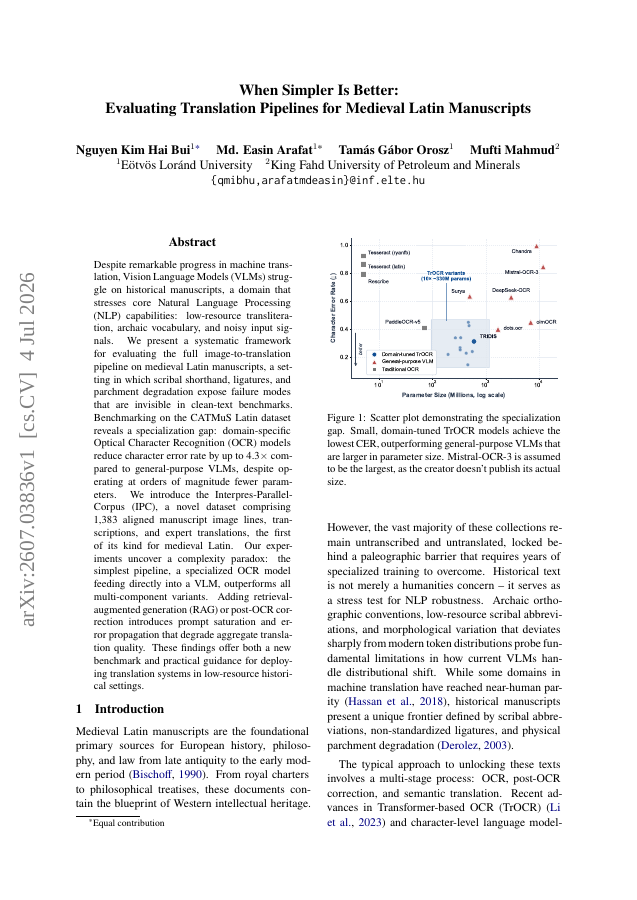
Despite remarkable progress in machine translation, Vision Language Models (VLMs) struggle on historical manuscripts, a domain that stresses core Natural Language Processing (NLP) capabilities: low-resource transliteration, archaic vocabulary, and noisy input signals. We present a systematic framework for evaluating the full image-to-translation pipeline on medieval Latin manuscripts, a setting in which scribal shorthand, ligatures, and parchment degradation expose failure modes that are invisible in clean-text benchmarks. Benchmarking on the CATMuS Latin dataset reveals a specialization gap: domain-specific Optical Character Recognition (OCR) models reduce character error rate by up to 4.3\times compared to general-purpose VLMs, despite operating at orders of magnitude fewer parameters. We introduce the Interpres-Parallel-Corpus (IPC), a novel dataset comprising 1,383 aligned manuscript image lines, transcriptions, and expert translations, the first of its kind for medieval Latin. Our experiments uncover a complexity paradox: the simplest pipeline, a specialized OCR model feeding directly into a VLM, outperforms all multi-component variants. Adding retrieval-augmented generation (RAG) or post-OCR correction introduces prompt saturation and error propagation that degrade aggregate translation quality. These findings offer both a new benchmark and practical guidance for deploying translation systems in low-resource historical settings.
When Simpler Is Better: Evaluating Translation Pipelines for Medieval Latin Manuscripts
Despite remarkable progress in machine translation, Vision Language Models (VLMs) struggle on historical manuscripts, a domain that stresses core Natural Language Processing (NLP) capabilities: low-resource transliteration, archaic vocabulary, and noisy input signals.
- Preview
- Year
- 2026
- Hosting
- Full text hostedCC-BY-4.0
Cite
Notes
Only stored in your browser.
Attribution
- Abstract & full text
- arxiv.org/abs/2607.03836CC-BY-4.0
- TL;DR
- Semantic Scholar